
The rice cooker is one of those appliances that proves how simple ideas can change everyday life, however, the question “How many watts does a rice cooker use?”. A pot, a heating element, and a timer together they transform raw grains into fluffy, steaming rice with almost no effort. For households where rice is a daily meal, the rice cooker isn’t just a machine it’s a quiet partner in the kitchen. But like every partner, it has a cost. So,
How much does an average rice cooker spend?
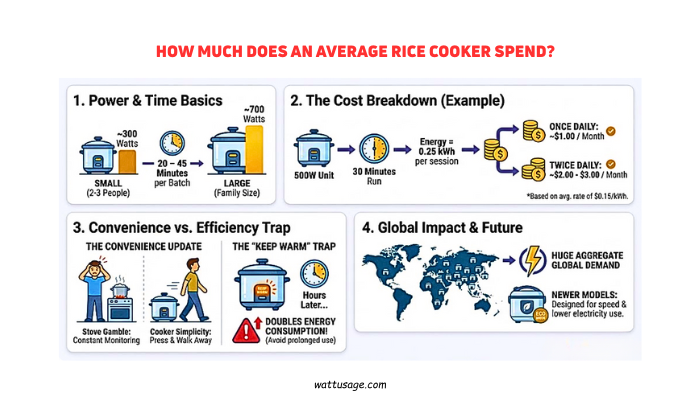
On average, a rice cooker consumes between 200 and 700 watts, depending on the size and model. Smaller cookers for two or three people usually use around 300 watts, while larger family-sized ones can draw up to 700 watts. The actual energy consumed depends on cooking time, which is usually 20 to 45 minutes for most batches of rice.
A quick math; 500-watt rice cooker running for 30 minutes will use about 0.25 kWh per cooking session. If you cook rice once a day, that’s 7.5 kWh per month. At an average electricity rate of $0.15 per kWh, the cost comes to just over $1 a month. Even if you use it twice daily, the total monthly cost rarely goes beyond $2 to $3.
This makes the rice cooker one of the most affordable appliances in terms of energy use. For the comfort it provides perfect rice without supervision it spends surprisingly little.
I still remember the days before we had a rice cooker at home. Cooking rice on the stove was always a gamble. Sometimes it came out too sticky, other times too hard. You had to watch over it, adjusting heat, stirring, and hoping it wouldn’t burn. The rice cooker changed all that. Suddenly, it was simple: measure rice, add water, press a button, and walk away. When you return, the rice is ready soft, warm, and waiting.
But while the rice cooker spends little, it can still spend wastefully if misused. Leaving it on “keep warm” mode for hours, for instance, can double its energy consumption. That gentle warming may feel convenient, but it quietly adds to the bill. Using the right amount of water and cooking in proper portions ensures the machine runs efficiently without unnecessary time or power.
From a global perspective, rice cookers are widely used across Asia, Africa, and beyond. Imagine millions of them working every day it may only be a dollar per household, but collectively it becomes a huge energy demand. The good news is that newer energy-efficient rice cookers are designed to cut down cooking time and minimise electricity use.
Are rice cookers energy efficient?
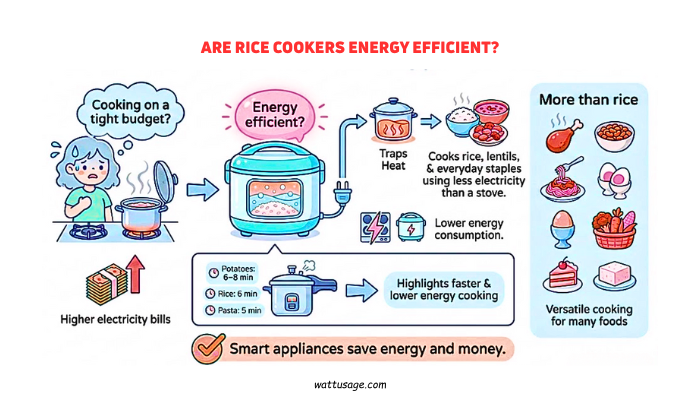
Cooking on a tight budget without a full stove can be challenging. Many small apartments rely on hot plates or induction stoves, which can quickly add up on electricity bills. For those whose diets rely heavily on rice, lentils, or simple staples, rice cookers have become a popular alternative. But are they really energy efficient?
Rice cookers work by containing heat effectively, allowing rice, lentils, and even a variety of other foods to cook evenly with minimal energy loss. Basic models, like those from Black & Decker, use relatively low power compared to a stovetop or hot plate. For small portions, the energy savings are noticeable, especially when avoiding constant monitoring and stirring.
Beyond rice, modern rice cookers, including high-end Japanese models, can cook a surprising range of foods: whole chickens, roast pork, beans, pasta, steamed vegetables, boiled eggs, cakes, and even tofu. The contained heat allows for consistent cooking results without constantly consuming extra energy.
For those looking to further reduce electricity use, combining a rice cooker with other energy-saving methods can help. Pressure cookers, for example, can prepare potatoes in 6–8 minutes, rice in 6 minutes, and pasta in 5 minutes. Foods that normally take hours can often be cooked in tens of minutes. Pressure cookers also retain heat efficiently when the lid is closed, reducing wasted energy.
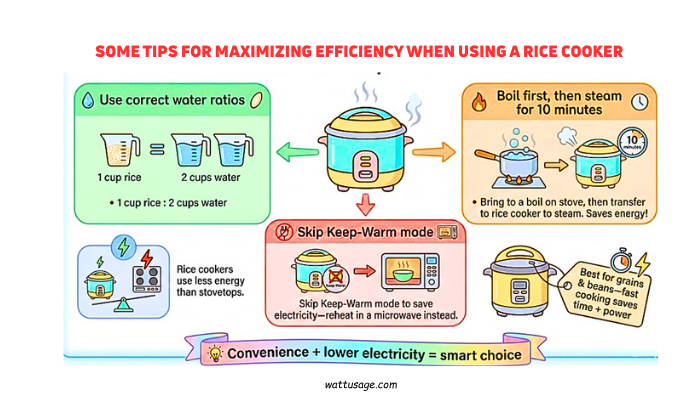
Some tips for maximizing efficiency when using a rice cooker include:
- Use the precise water-to-rice ratio (for parboiled rice, 1 part rice to 2 parts water).
- Bring water to a boil, then turn off the heat and allow the rice to steam for 10 minutes.
- Avoid using “keep warm” functions; instead, reheat food in a microwave when needed.
While rice cookers won’t drastically cut energy costs on their own, they offer convenience, consistent results, and lower energy usage compared to many stovetop methods. For vegetarians or anyone relying on grains and legumes, a rice cooker combined with other energy-efficient cooking tools, like a pressure cooker, can make a big difference in both time and electricity use.
Conclusion:
Rice cookers are a surprisingly energy-efficient kitchen companion. Consuming between 200 and 700 watts per use, they provide perfectly cooked rice and other foods with minimal supervision, making them ideal for daily meals. Even with frequent use, the monthly electricity cost rarely exceeds $2–3, making them one of the most affordable appliances in terms of energy use.
Beyond rice, modern rice cookers can handle a wide variety of foods, from lentils and beans to meats, pasta, and even baked goods, all while containing heat efficiently and reducing energy waste. To maximize efficiency, it’s best to use the right water-to-rice ratio, cook in proper portions, and avoid leaving the appliance on “keep warm” for extended periods.
When combined with other energy-saving tools, such as pressure cookers, rice cookers can play a key role in reducing electricity bills, saving time, and simplifying meal preparation. For households focused on grains, legumes, or simple cooking, rice cookers offer both convenience and energy efficiency, proving that small appliances can make a big difference.
Are rice cookers energy efficient?
Yes. Most rice cookers use between 200–700 watts per cooking session, making them more energy-efficient than stovetops or hot plates, especially for small portions.
How can I reduce electricity use when using a rice cooker?
Use the correct water-to-rice ratio, cook in proper portions, avoid extended “keep warm” mode, and combine cooking with other energy-saving appliances like pressure cookers.
