
For many of us, mornings don’t truly begin until the coffee maker hums to life. How much does an average coffee maker uses? with that rich aroma, the slow drip, and the warmth in a cup, it feels less like a machine at work and more like a ritual waking us up. The coffee maker is not just about brewing coffee; it’s about starting the day with energy. But like every comforting ritual, it comes with a cost. So, How Many Watts Does a Coffee Maker Use?
On average, a standard drip coffee maker uses between 600 and 1,200 watts when brewing. Single-serve machines like pod brewers usually fall on the lower end, while larger drip or espresso machines can reach the higher side. Brewing a pot of coffee usually takes about 5 to 10 minutes, which means the actual electricity consumption per use is fairly low. Let’s try to understand watts used by a coffee maker.
Coffee maker electricity consumption
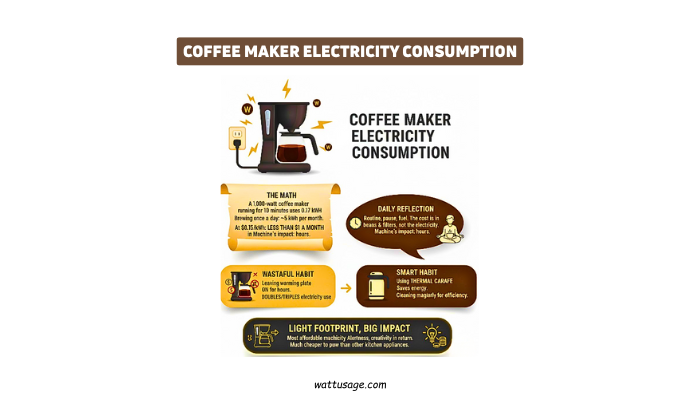
Let’s do the math for a coffee maker electricity consumption:
- A 1,000-watt coffee maker running for 10 minutes uses 0.17 kWh.
- If you brew coffee once a day, that equals about 5 kWh per month.
- At $0.15 per kWh, that’s less than $1 a month in electricity costs.
That makes the coffee maker one of the most affordable machines to run in the kitchen. The beans, filters, or pods may add to the expense, but the electricity itself barely dents the budget.
While the coffee maker doesn’t spend much energy, it spends something else, time and habit. For millions of people around the world, coffee brewing is not just about caffeine. It’s about routine, a small pause before stepping into the rush of the day. The machine may hum for only a few minutes, but its impact lasts for hours.
Of course, the way we use it can still make a difference. Some people leave the warming plate on for hours, keeping coffee hot long after brewing. This can double or triple electricity use unnecessarily. Using a thermal carafe instead saves energy by keeping coffee warm without constant heating. Cleaning the machine regularly also ensures it brews efficiently without overworking.
I remember during exam weeks, when nights turned into mornings, my coffee maker felt like a loyal friend. Each cup felt like fuel, keeping me awake when my eyes wanted to close. But when the electricity bill arrived, I realised something, the coffee itself was expensive, not the brewing. The machine was never the spender, it was my reliance on it that made me think otherwise.
From a bigger perspective, imagine millions of coffee makers running every morning around the globe. Each spends only cents, but together, they represent a massive daily ritual powered by energy. Thankfully, compared to bigger appliances, their footprint is light, almost symbolic of how small comforts can come without heavy costs.
In my view, the coffee maker is not just about watts and bills. It is about beginnings, about little moments of warmth and clarity. It spends little electricity, but it gives us a lot more back, alertness, comfort, and sometimes even creativity. That’s a trade I’m always willing to make.
How many watts does a coffee maker use?
Most home espresso machines use 0.3 to 1.8 kWh per day, depending on boiler size and how long they remain powered on. A machine like the Lelit Mara X averages 0.75–0.8 kWh/day, while smaller single-boiler machines like the Rancilio Silvia or Gaggia Classic use 0.2–0.34 kWh/day.
Dual-boiler setups consume more energy, especially if the steam boiler is active. Turning the machine on only during coffee sessions or using a timer can significantly reduce costs. For near-zero energy use, manual espresso makers are the most efficient choice.
You would would be wondering why, right? Its very simple look, in with manual coffee maker you are not supposed to warm the water with the coffee maker you use. You borrow warm water to the coffee maker and then you make a coffee for your daily adventure.
But wait I have something to tell you, how many watts does a coffee maker use? This question isn’t all about how many. Coffee maker varies by size, mechanism and mostly how long it will last.
Let me give you a scenario have you every noticed in movies this, “in movies, the office coffee maker is always ready to use, like warm and perfectly ready to make a coffee with. This is because they have to use coffee for relaxation in between the gaps from their work loads.”
So its not only that which coffee maker to you use other factors like duration and mechanism of the coffee you use.
In my view the most important part while using a coffee maker is that you don’t need to worry about “how many watts does a coffee maker use?” but, “how long does a coffee maker I use daily?”. When you get data of how long you use multiple it with the cost per KWh you will get how much your coffee maker use.
To understand electricity use, focus on how long your coffee maker runs, not just the watt number.
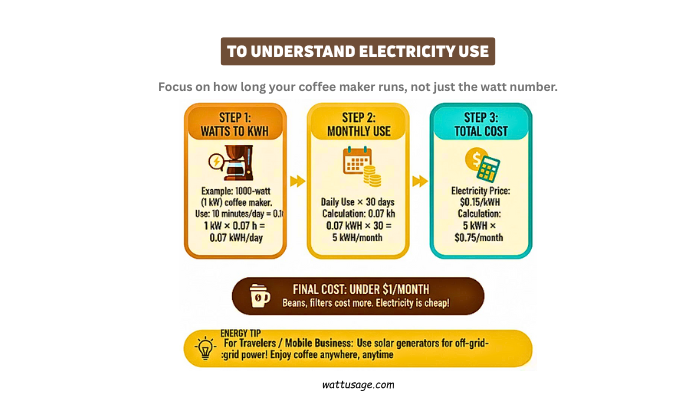
Step 1: Convert watts to kWh
Example: A 1000-watt (1 kW) coffee maker
If you use it for 10 minutes per day, convert minutes to hours:
10 minutes = 10/60 = 0.167 hours
Electricity used:
1 kW × 0.167 hours = 0.167 kWh per day
Step 2: Multiply by days
Monthly use:
0.167 kWh × 30 = 5 kWh per month
Step 3: Multiply by electricity price
If electricity costs $0.15 per kWh:
5 kWh × $0.15 = $0.75 per month
This is how you get the your coffee maker’s cost.
Let me add here something for travellers and those who’s coffee business is movable.
Do we need generators for Coffee makers?
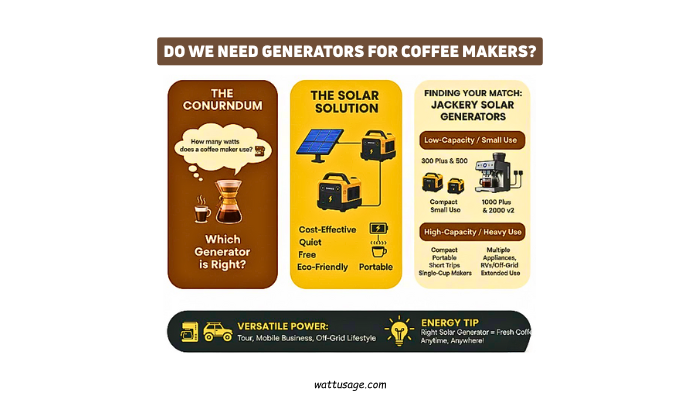
We obviously need a generator for a coffee maker. It’s hardly a logical question, even when asking, ‘How many watts does a coffee maker use? So yeah we need a generator for a coffee maker but the question here is what and which kind of generator do we need. Let’s explore together.
These days solar generators are perfect for powering coffee makers off-grid, offering a cost-effective, quiet, free, and Eco-Friendly alternative to fuel generators and use your coffee maker whether you are on a tour or you have a movable business.
The Jackery solar generator range offers options for every off-grid coffee maker need. For low-budget or small-capacity use, the Jackery Solar Generator 300 Plus and 500 are compact, portable, and ideal for powering single-cup or small drip coffee makers during short outdoor trips.
For high-capacity or heavy use, the Jackery Solar Generator 1000 Plus (1264 Wh) and 2000 v2 (2042 Wh) provide enough energy to run larger coffee machines, multiple appliances simultaneously, and support extended camping, RV living, or off-grid setups. The 1000 Plus, in particular, offers multiple ports and optional add-on batteries, making it versatile for repeated daily coffee brewing.
In short, having a generator for your coffee maker is essential, but choosing the right one makes all the difference. Solar generators, especially the versatile Jackery range, provide a reliable, Eco-Friendly, and convenient solution for every need whether it’s a solo outdoor trip, a mobile business, or a fully off-grid lifestyle. With the right solar generator, you can enjoy fresh coffee anytime, anywhere, without compromise.
Conclusion
Coffee makers are more than just kitchen appliances, they are a morning ritual, a moment of comfort, and a small but meaningful part of our daily lives. While the wattage of a coffee maker varies depending on size, type, and mechanism, the real factor that determines electricity cost is how long you use it each day.
From small single-serve machines to dual-boiler espresso setups, understanding your usage and calculating costs can help you enjoy your coffee without worrying about high electricity bills.
For travelers, campers, or mobile coffee businesses, solar generators offer a convenient and eco-friendly solution. The Jackery solar generator range, from small, portable models like the 300 Plus to high-capacity options like the 2000 v2, ensures you can brew coffee anywhere, anytime, without compromise. Whether for a solo camping trip, RV living, or off-grid setups, choosing the right generator guarantees fresh coffee with minimal energy waste.
FAQs: Coffee Maker Wattage & Electricity Use
Q1: How many watts does a typical coffee maker use?
- Small drip machines: 550–900 watts
- Large drip machines: 750–1200 watts
- Single-serve pod machines: 900–1500 watts
- Automatic espresso machines: 1000–1500 watts (for extreme cases)
Q2: How much electricity does a coffee maker actually consume?
- A 1000-watt coffee maker used for 10 minutes/day consumes ~0.17 kWh/day (~5 kWh/month).
- At $0.15 per kWh, that’s under $1/month.
Q3: Do dual-boiler espresso machines use more energy?
- Yes, especially if the steam boiler is left on continuously.
- Using a timer or turning the machine on only during coffee sessions can save energy.
Q4: What is the most energy-efficient coffee maker?
- Manual espresso makers use near-zero electricity, as they don’t heat water themselves. Only the water you add needs energy to heat externally.
Q5: Do I need a generator for my coffee maker?
- Yes, for off-grid or mobile setups.
- Solar generators are recommended, they’re quiet, eco-friendly, and cost-effective.
Q6: Which solar generator is best for coffee makers?
- Small/light use: Jackery 300 Plus, Jackery 500
- High-capacity/heavy use: Jackery 1000 Plus (1264 Wh), Jackery 2000 v2 (2042 Wh)
- The 1000 Plus allows multiple appliances and supports add-on batteries for extended use.
Read Our Main Article Here
