When you wonder How Many Watts Does an Iron Use, electricity bills and energy efficiency may immediately come to mind.
The answer depends on iron type, temperature setting, and daily usage.
Understanding iron wattage helps plan electricity costs while ensuring clothes are perfectly pressed without waste.
Modern irons are designed to heat quickly while using electricity efficiently.
From basic dry irons to steam and advanced steam generator irons, energy consumption can vary.
Types of Irons and Their Wattage
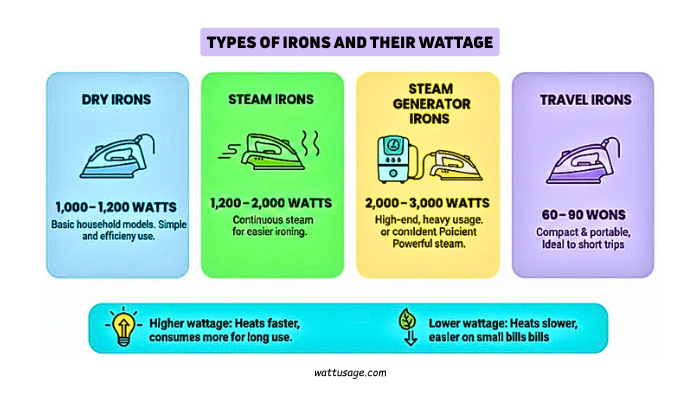
How Many Watts Does an Iron Use depends largely on the type and model:
- Dry irons: Basic household models typically use 1,000–1,200 watts.
- Steam irons: Provide continuous steam for easier ironing, usually 1,200–2,000 watts.
- Steam generator irons: High-end models for heavy usage; 2,000–3,000 watts.
- Travel irons: Compact models with 600–900 watts, ideal for short-term use.
Higher wattage irons heat faster, but may consume more electricity if used for long periods.
Lower wattage irons take longer to reach temperature but are easier on small electricity bills.
Daily and Monthly Electricity Use
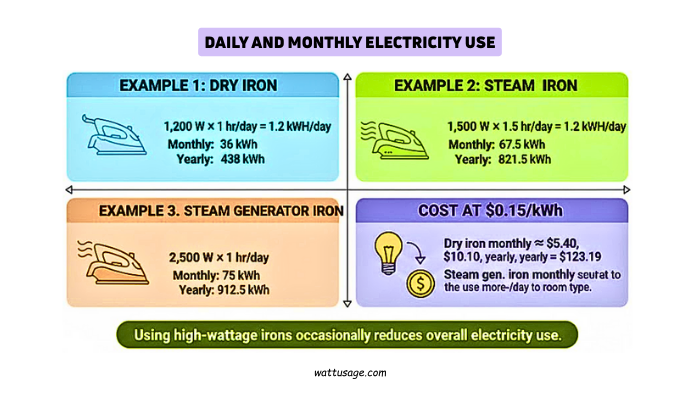
To calculate electricity consumption, multiply wattage by operating hours.
Example 1: Dry iron at 1,200 watts used 1 hour/day
- 1,200 W × 1 hr = 1.2 kWh/day
- Monthly: 1.2 × 30 = 36 kWh
- Yearly: 1.2 × 365 = 438 kWh
Example 2: Steam iron at 1,500 watts used 1.5 hours/day
- 1,500 W × 1.5 hr = 2.25 kWh/day
- Monthly: 67.5 kWh
- Yearly: 821.25 kWh
Example 3: Steam generator iron at 2,500 watts for 1 hour/day
- 2,500 W × 1 hr = 2.5 kWh/day
- Monthly: 75 kWh
- Yearly: 912.5 kWh
At $0.15 per kWh:
- Dry iron monthly ≈ $5.40, yearly ≈ $65.70
- Steam iron monthly ≈ $10.13, yearly ≈ $123.19
- Steam generator iron monthly ≈ $11.25, yearly ≈ $136.88
Using high-wattage irons occasionally reduces overall electricity use.
Factors Affecting Electricity Use
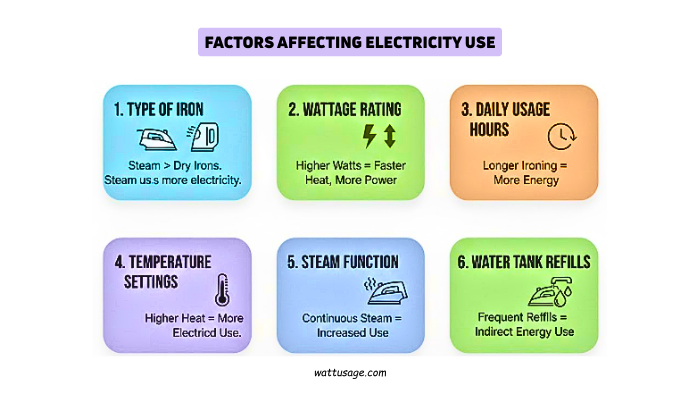
Electricity use varies due to several factors:
- Type of iron: Steam irons use more electricity than dry irons.
- Wattage rating: Higher wattage irons heat faster but use more power.
- Daily usage hours: Longer ironing increases energy consumption.
- Temperature settings: Higher heat requires more electricity.
- Steam function usage: Continuous steam increases electricity consumption.
- Water tank refill frequency: Filling water often for steam irons uses energy indirectly.
Even small changes, like ironing larger batches at once, can save energy.
Understanding How Many Watts Does an Iron Use helps select the best iron for your needs.
Iron Wattage Comparison Table
| Iron Type | Typical Wattage | Daily Use (1–1.5 hrs) | Monthly kWh | Annual Cost ($) |
|---|---|---|---|---|
| Dry Iron | 1,000–1,200 W | 1.2 kWh | 36 kWh | 5.40 |
| Steam Iron | 1,200–2,000 W | 2.25 kWh | 67.5 kWh | 10.13 |
| Steam Generator | 2,000–3,000 W | 2.5 kWh | 75 kWh | 11.25 |
| Travel Iron | 600–900 W | 0.75 kWh | 22.5 kWh | 3.38 |
This table highlights how iron type and usage influence electricity bills.
Steam irons are convenient but consume more electricity than dry or travel models.
Real-Life Household Example
A household using irons daily for various tasks may see:
- Dry ironing: 1 hour
- Steam ironing: 1.5 hours
- Travel iron: 0.5 hour for small items
Daily electricity consumption:
- Dry iron: 1,200 W × 1 hr = 1.2 kWh
- Steam iron: 1,500 W × 1.5 hr = 2.25 kWh
- Travel iron: 900 W × 0.5 hr = 0.45 kWh
- Total = 3.9 kWh/day
Monthly: 3.9 × 30 ≈ 117 kWh
Yearly: 3.9 × 365 ≈ 1,423.5 kWh
At $0.15/kWh:
- Monthly ≈ $17.55
- Yearly ≈ $213.53
Choosing efficient irons or consolidating ironing sessions can significantly reduce costs.
Tips to Reduce Electricity Use
- Choose an iron with wattage suited to your typical usage.
- Use dry ironing whenever possible to save electricity.
- Iron larger batches in one session instead of multiple small sessions.
- Use the steam function only when necessary.
- Unplug the iron immediately after use to avoid standby power consumption.
- Maintain the iron properly to ensure fast heating and energy efficiency.
Small habits like these save electricity and extend the iron’s lifespan.
Irons consume electricity, contributing to household energy use and carbon footprint.
Using energy-efficient models and reducing operating hours lowers electricity bills and emissions.
Steam generator irons, though efficient for large batches, use more electricity than smaller dry irons.
Smart usage habits benefit both your wallet and the environment.
Maintenance and Efficiency
- Clean the soleplate regularly for efficient heat transfer.
- Remove mineral deposits from steam irons to prevent energy waste.
- Check the cord and plug for safe operation.
- Avoid using damaged or old irons, which may consume extra electricity.
- Proper storage prevents accidents and ensures the iron is ready for energy-efficient use.
Maintaining the iron ensures consistent performance while minimizing electricity consumption.
Travel vs Household Irons
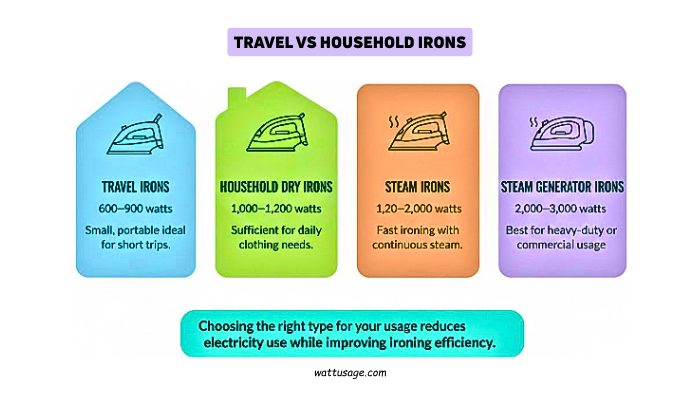
Travel irons: 600–900 watts, small, portable, ideal for short trips.
Household dry irons: 1,000–1,200 watts, sufficient for daily clothing needs.
Steam irons: 1,200–2,000 watts, provide fast ironing with continuous steam.
Steam generator irons: 2,000–3,000 watts, best for heavy-duty or commercial usage.
Choosing the right type for your usage reduces electricity use while improving ironing efficiency.
Conclusion
Household irons consume 600–3,000 watts depending on type and model.
Dry irons: 1,000–1,200 watts, steam irons: 1,200–2,000 watts, steam generators: 2,000–3,000 watts.
Daily and monthly electricity use depends on hours of use, temperature, and steam settings.
Using energy-efficient irons and smart ironing habits reduces electricity bills and environmental impact.
Understanding How Many Watts Does an Iron Use helps manage energy and choose the right iron.
F&Qs
Q1: Do all irons use the same electricity?
No, dry irons consume less than steam or steam generator irons.
Q2: Does using steam significantly increase power use?
Yes, continuous steam draws more electricity than dry ironing.
Q3: How can I calculate my iron’s electricity cost?
Multiply wattage × hours of use to get kWh, then convert to monthly or yearly cost.
Q4: Are travel irons more efficient than household irons?
Yes, lower wattage and short usage make them energy-friendly for small tasks.
Q5: Can batch ironing save electricity?
Absolutely, ironing multiple clothes at once reduces total heating cycles.
