
When you wonder How Many Watts Does a Light Bulb Use, you are likely thinking about electricity bills and energy efficiency.
Different types of bulbs use varying amounts of power, which affects both costs and environmental impact.
Understanding bulb wattage helps you make smart choices for your home while saving money and energy.
Modern lighting technology has greatly reduced power consumption while still providing bright, comfortable light.
From traditional incandescent bulbs to LED and CFL bulbs, energy use can vary widely.
Types of Light Bulbs and Their Wattage
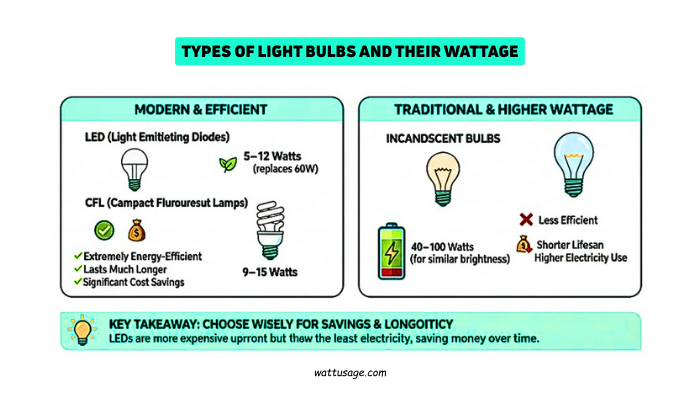
How Many Watts Does a Light Bulb Use depends on the type of bulb you choose.
- Incandescent bulbs: Classic bulbs with warm light, typically 40–100 watts.
- Compact Fluorescent Lamps (CFL): More energy-efficient, around 9–15 watts for similar brightness.
- Light Emitting Diodes (LED): Extremely energy-efficient, 5–12 watts can replace a 60-watt incandescent bulb.
The type of bulb determines daily electricity consumption and long-term costs.
LEDs, while slightly more expensive upfront, consume the least electricity and last longer.
Even using multiple bulbs, energy-efficient types reduce electricity usage significantly.
Daily and Monthly Electricity Use
To calculate energy usage, multiply the bulb’s wattage by daily operating hours.
Example for a 60-watt incandescent bulb:
- 60 watts × 5 hours/day = 0.3 kWh/day
- Monthly: 0.3 × 30 = 9 kWh
- Yearly: 0.3 × 365 = 109.5 kWh
An LED equivalent of 10 watts:
- 10 watts × 5 hours/day = 0.05 kWh/day
- Monthly: 1.5 kWh
- Yearly: 18.25 kWh
At $0.15 per kWh, electricity cost for incandescent:
- Monthly ≈ $1.35
- Yearly ≈ $16.43
For LED bulbs, the cost drops drastically:
- Monthly ≈ $0.23
- Yearly ≈ $2.74
This demonstrates why choosing energy-efficient lighting matters for both cost and the environment.
Factors Affecting Electricity Consumption
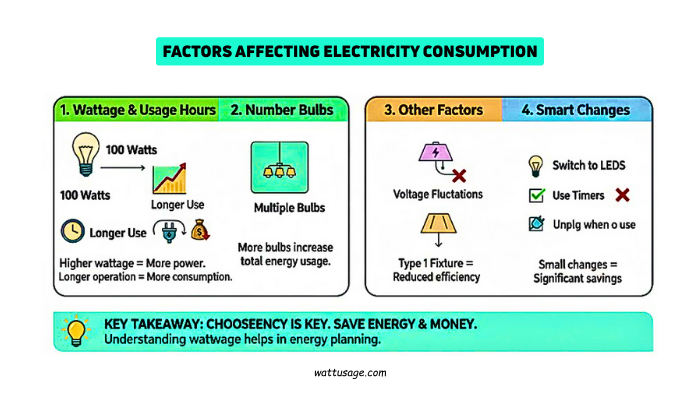
Several factors influence how much electricity a bulb consumes:
- Wattage rating: Higher wattage bulbs consume more power.
- Usage hours: Longer daily operation increases consumption.
- Number of bulbs: More bulbs increase total energy usage.
- Voltage fluctuations: Inconsistent voltage may slightly affect power draw.
- Type of fixture: Some lamps or enclosed fixtures reduce efficiency.
Even small changes, like switching to LEDs or using timers, can significantly reduce total electricity consumption.
Understanding How Many Watts Does a Light Bulb Use allows for more precise energy planning.
Light Bulb Wattage Comparison Table
| Bulb Type | Typical Wattage | Daily kWh (5 hrs) | Monthly kWh | Annual Cost ($) |
|---|---|---|---|---|
| Incandescent 40W | 40 W | 0.2 kWh | 6 kWh | 0.90 |
| Incandescent 60W | 60 W | 0.3 kWh | 9 kWh | 1.35 |
| CFL 9W | 9 W | 0.045 kWh | 1.35 kWh | 0.20 |
| LED 10W | 10 W | 0.05 kWh | 1.5 kWh | 0.23 |
This table shows the difference in energy use between traditional and energy-saving bulbs.
Switching to LEDs can reduce electricity costs by more than 80%.
Tips to Reduce Lighting Electricity Use
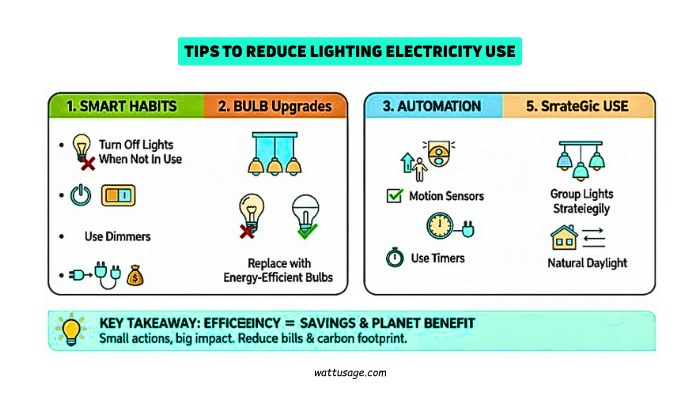
- Replace incandescent bulbs with LEDs or CFLs.
- Use dimmers where possible to lower energy use.
- Turn off lights when not in use.
- Consider motion sensors or timers in low-traffic areas.
- Group lights strategically to avoid unnecessary bulbs.
Small actions save money and reduce electricity consumption significantly over time.
Even keeping lights off when leaving a room daily can add up to large annual savings.
Lighting accounts for a notable portion of home energy use.
Using energy-efficient bulbs reduces carbon emissions and reliance on electricity from fossil fuels.
LEDs last much longer, reducing waste compared to short-lived incandescent bulbs.
Switching to low-wattage options keeps electricity bills low and benefits the planet.
Conclusion
Understanding How Many Watts Does a Light Bulb Use helps make informed decisions for home lighting.
Incandescent bulbs use 40–100 watts, CFLs around 9–15 watts, and LEDs 5–12 watts.
Daily electricity cost depends on bulb wattage and hours of use.
Switching to LEDs and using simple energy-saving habits greatly reduces bills and environmental impact.
F&Qs
Q1: Do all 60-watt bulbs consume the same electricity?
No, CFL or LED bulbs produce the same brightness using far less electricity.
Q2: How can I calculate my light bulb cost?
Multiply wattage × hours of use = daily kWh, then extend for month or year.
Q3: Do dimmers reduce electricity use?
Yes, dimming lights lowers energy use proportionally.
Q4: Can timers save electricity?
Absolutely, they prevent lights from staying on unnecessarily.
Q5: Are LEDs worth the higher upfront cost?
Yes, they last longer, use less power, and reduce yearly electricity bills.
