
When you wonder How Many Watts Does an Electric Stove Use, electricity bills often come to mind.
The answer depends on the type of stove, the number of burners, and how long you cook.
Understanding wattage helps you plan energy costs while cooking efficiently and keeping your home comfortable.
Modern stoves are designed to balance fast heating with energy efficiency.
From simple coil stoves to high-end induction units, power consumption can vary significantly.
Types of Electric Stoves and Typical Wattage
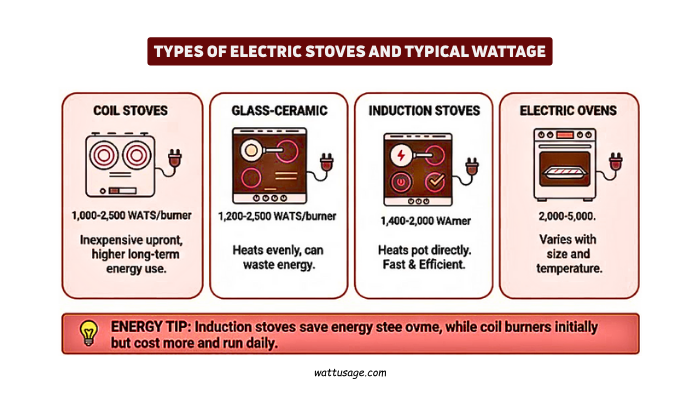
Electric Stove Use depends largely on the stove type:
- Coil or traditional electric stoves: Each burner usually draws 1,000–2,500 watts.
- Glass-ceramic stoves: 1,200–2,500 watts per burner. These heat evenly but may waste energy in poorly insulated areas.
- Induction stoves: 1,400–2,000 watts per burner, heating the pot directly for faster, efficient cooking.
- Electric ovens: Standalone ovens typically use 2,000–5,000 watts, depending on size and temperature settings.
Each stove type has pros and cons regarding electricity use.
Induction stoves may cost more initially, but energy savings and speed make them efficient.
Traditional coil burners are inexpensive upfront but consume more electricity over time.
How Daily and Monthly Electricity Use Adds Up
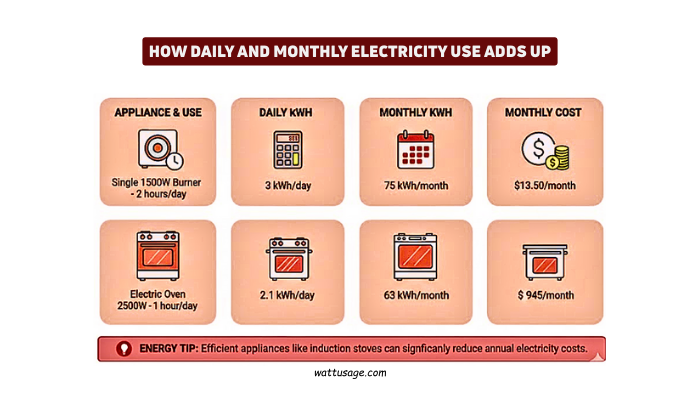
Calculating daily electricity consumption is straightforward: multiply wattage by operating hours.
Single 1,500-watt burner for 2 hours/day
- 1,500 W × 2 hours = 3 kWh/day
- Monthly: 3 × 30 = 90 kWh
- Yearly: 3 × 365 = 1,095 kWh
Electric oven at 2,500 watts for 1 hour/day
- 2,500 W × 1 hour = 2.5 kWh/day
- Monthly: 75 kWh
- Yearly: 912.5 kWh
Induction burner at 1,400 watts for 1.5 hours/day
- 1,400 W × 1.5 hours = 2.1 kWh/day
- Monthly: 63 kWh
- Yearly: 766 kWh
At $0.15 per kWh, monthly costs:
- Standard burner: $13.50
- Oven: $11.25
- Induction: $9.45
This demonstrates that switching to efficient appliances can save money annually.
Factors Affecting Electricity Consumption
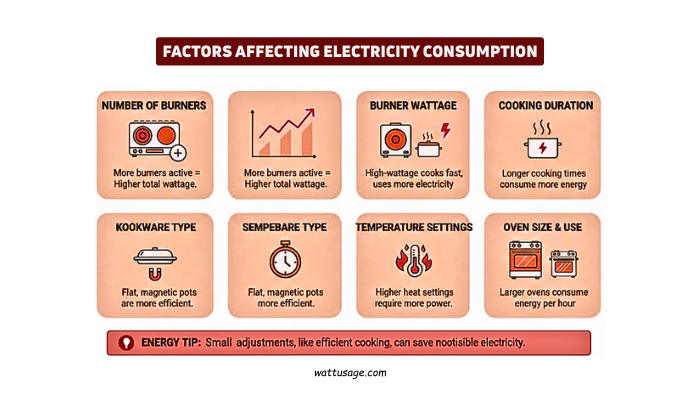
Electricity use depends on multiple factors:
- Number of active burners: More burners increase total wattage use.
- Burner wattage: High-wattage burners cook faster but use more electricity.
- Cooking duration: Longer cooking times consume more energy.
- Cookware type: Flat-bottomed, magnetic cookware is more efficient, especially for induction stoves.
- Temperature settings: Higher heat requires more electricity.
- Oven size and usage: Larger ovens consume more energy per hour.
Even small adjustments, like using fewer burners or cooking efficiently, save noticeable electricity many watts of an electric stove Usage.
Stove Wattage Comparison Table
| Stove Type | Burner/Oven Wattage | Daily Use | Monthly kWh | Annual Cost ($) |
|---|---|---|---|---|
| Standard Coil | 1,500 W | 3 kWh | 90 kWh | 13.50 |
| High-Watt Coil | 2,500 W | 5 kWh | 150 kWh | 22.50 |
| Induction | 1,400 W | 2.1 kWh | 63 kWh | 9.45 |
| Electric Oven | 2,500 W | 2.5 kWh | 75 kWh | 11.25 |
This table highlights the difference in electricity use between stove types.
Induction stoves consistently offer lower energy consumption for the same cooking results.
Real-Life Household Example
Imagine a family of four using an electric stove daily:
- Breakfast: 1 burner, 0.5 hours
- Lunch: 2 burners, 1 hour
- Dinner: Oven, 1 hour
Daily consumption:
- Breakfast: 1,500 W × 0.5 hr = 0.75 kWh
- Lunch: 2,500 W × 1 hr = 2.5 kWh
- Dinner: Oven 2,500 W × 1 hr = 2.5 kWh
- Total = 5.75 kWh/day
Monthly: 5.75 × 30 = 172.5 kWh
Yearly: 5.75 × 365 = 2,098.75 kWh
At $0.15/kWh:
- Monthly cost = $25.88
- Yearly cost = $314.81
Switching to induction for lunch and dinner could reduce daily consumption to 3.9 kWh/day, lowering annual electricity costs by nearly $120.
Tips to Reduce Electricity Use
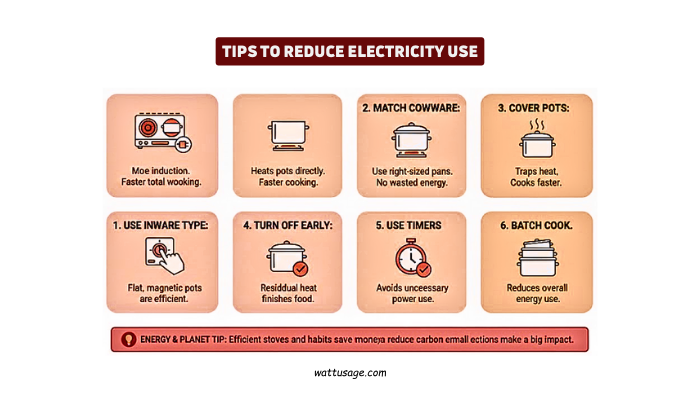
- Use induction stoves: Heat pots directly and cook faster.
- Match cookware to burner size: Prevent wasted energy.
- Cover pots and pans: Retain heat and reduce cooking time.
- Turn off burners slightly early: Residual heat finishes cooking.
- Use timers: Avoid leaving burners or ovens on unnecessarily.
- Cook efficiently: Batch-cooking meals reduces overall energy use.
If you wondered for so long that, “How Many Watts Does an Electric Stove Use?”These simple habits can save hundreds of dollars each year.
Cooking consumes electricity, contributing to household carbon emissions.
Using energy-efficient stoves, induction technology, and efficient cookware reduces electricity consumption.
Fewer watts used means less energy drawn from power plants, lowering environmental impact.
Small actions, like shorter cooking times and covered pots, help the planet while saving money.
Maintenance and Efficiency
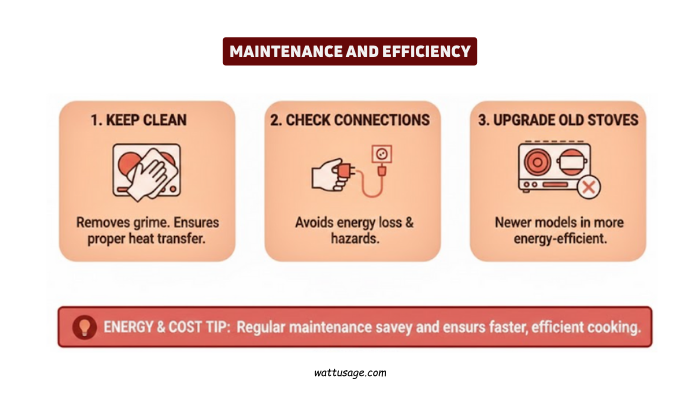
- Keep burners and oven elements clean to maintain proper heat transfer.
- Check electrical connections to avoid energy loss.
- Replace old or damaged stoves with energy-efficient models.
- Regular maintenance ensures burners and ovens reach temperature quickly, saving electricity.
Efficient operation ensures minimal energy wastage during daily cooking.
Industrial vs Home Stoves
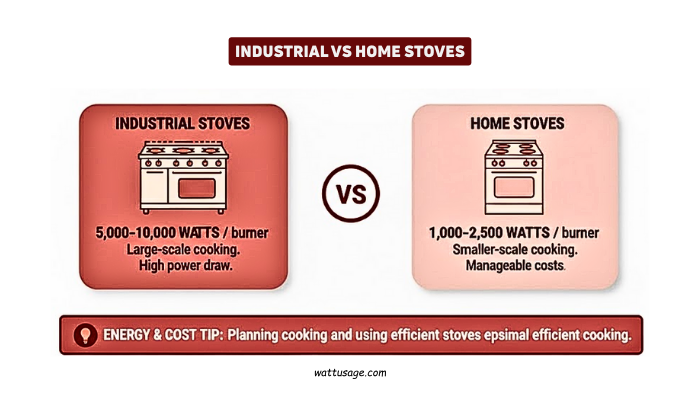
Industrial electric stoves often draw 5,000–10,000 watts for large-scale cooking.
Home stoves are smaller, 1,000–2,500 watts per burner.
Even when used frequently, electricity costs for home stoves remain manageable.
Planning cooking hours and using energy-efficient stoves ensures optimal consumption.
Conclusion
Electric stoves draw 1,000–2,500 watts per burner depending on type and model.
Induction stoves are faster and more energy-efficient than coil or glass-top stoves.
Daily and monthly energy use depends on cooking hours, burners, and oven use.
Simple habits, efficient cookware, timers, and maintenance reduce electricity costs significantly.
Understanding stove wattage empowers households to cook efficiently while managing energy bills.
F&Qs
Q1: Do all burners consume the same electricity?
No, higher-wattage burners cook faster but use more electricity.
Q2: Are induction stoves really more efficient?
Yes, they heat the pot directly and waste less energy.
Q3: How can I calculate electricity cost for my stove?
Multiply wattage by daily hours, then convert to monthly or yearly kWh and cost.
Q4: Does using lids save electricity?
Absolutely, it keeps heat inside and reduces cooking time.
Q5: Can fewer burners reduce overall electricity use?
Yes, only use necessary burners to lower total energy consumption.
