
When you think about the cost of charging electric car at home, your mind likely goes to your electricity bill.
Most people worry that an EV will raise that bill too high.
The truth is more comforting: home charging is usually cheaper than fueling petrol cars.
Understanding this cost matters if you plan to buy an EV or want to save money now.
This post breaks down real numbers, real habits, and real savings.
We will cover home electricity use, charging setup, and long‑term costs.
What Cost of Charging Electric Car at Home Really Means
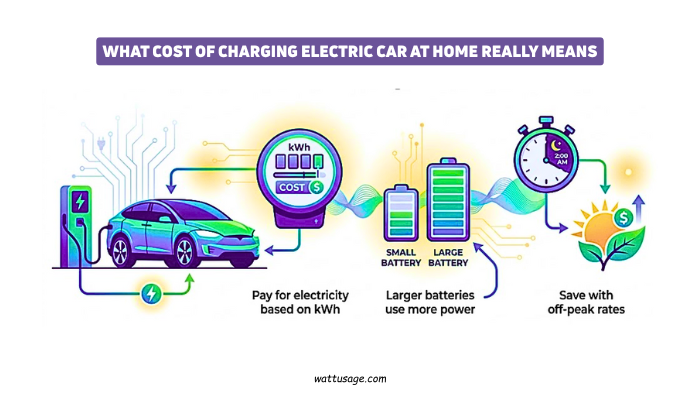
The cost of charging electric car at home is simply the electricity your EV uses.
You pay your normal electricity rate for every kilowatt‑hour (kWh) used.
Most people plug in at night or during low‑rate hours to save money.
The total cost depends on your car’s battery size and how far you drive.
Larger batteries take more electricity to fill from empty to full.
Smaller ones cost less because they need fewer kWh of electricity.
Some areas offer EV‑specific electricity plans, with cheaper off‑peak rates.
Charging off‑peak can cut your cost nearly in half in some places.
Simple planning like this keeps charging affordable and stress‑free.
How Home Charging Costs Add Up
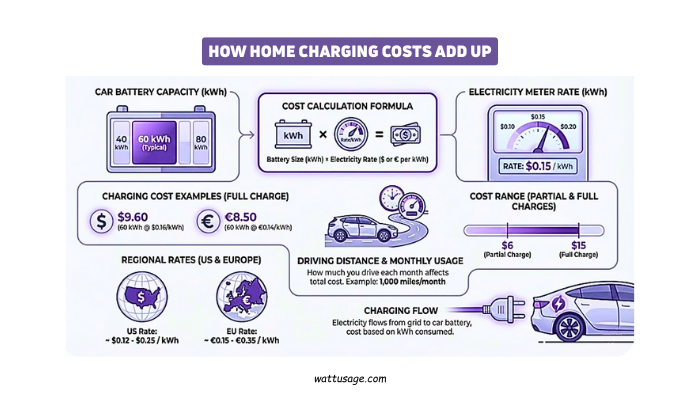
To understand your home charging cost, you need three numbers:
- Your car’s battery size in kWh
- Your electricity price per kWh
- How much you drive each month
Simple formula:
Total cost = Battery size × Electricity rate
For example, using the U.S. average electricity rate (~$0.16 per kWh), a typical 60 kWh battery costs:
- 60 kWh × $0.16 ≈ $9.60 for a full charge.
If you drive mostly short distances, you rarely charge fully.
Most EVs don’t go from 0% to 100% each time.
So most drivers pay $6 to $15 per full charge at home.
In other countries, costs vary with local electricity rates.
For example, in Europe, a full charge can cost around €15–€22 based on battery size and local rates.
Even partial charges add up slowly compared to petrol or diesel.
Real‑Life Charging Costs by Model
Electric car size and battery capacity affect cost directly.
Here are examples based on typical battery sizes and average electricity prices:
| EV Model | Battery (kWh) | Approx. Home Charging Cost |
|---|---|---|
| Tesla Model 3 | 75 | ~$12.75 |
| Hyundai IONIQ 5 | 77 | ~$11.61 |
| Kia EV9 | 99.8 | ~$16.97 |
| ID.4 | 62 | ~$10.54 |
These figures use roughly $0.17 per kWh average electricity rate.
Depending on your local rate, your costs could be higher or lower.
How Electricity Rates Affect Charging Costs
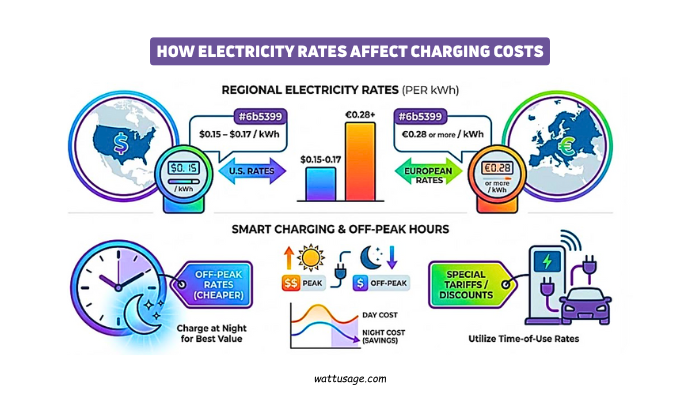
Your home electricity rate per kWh is the biggest cost factor.
Different places charge different amounts per unit of electricity.
Some regions have special night‑time or off‑peak rates for EV owners.
- In the U.S., average residential rates are around $0.15–$0.17 per kWh.
- In parts of Europe, rates may be €0.28 per kWh or more.
- Special tariffs can be as low as €0.15 per kWh or less during off‑peak hours.
If your utility offers time‑of‑use (TOU) plans, charging at night can cut cost significantly.
Smart charging setups let the car charge automatically during cheaper hours.
How Often You Drive Matters
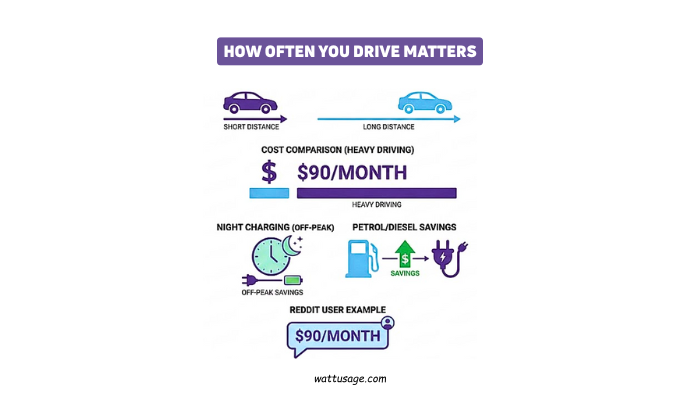
Your driving habits influence the cost strongly.
If you only drive short distances daily, your electricity cost stays low.
Charging a small amount adds only a few dollars to the monthly bill.
For heavy drivers, charging every day adds more cost.
One Reddit EV owner reported an increase of about $90/month in electricity after charging at home daily.
They charged mostly at night with off‑peak rates, which kept the bill reasonable.
Another example mentioned charging every night without tracking exact cost.
They said rates vary by state and utility, and costs depend on local kWh prices.
Even in that case, savings compared with petrol or diesel were large.
Installation Costs for Home Charging
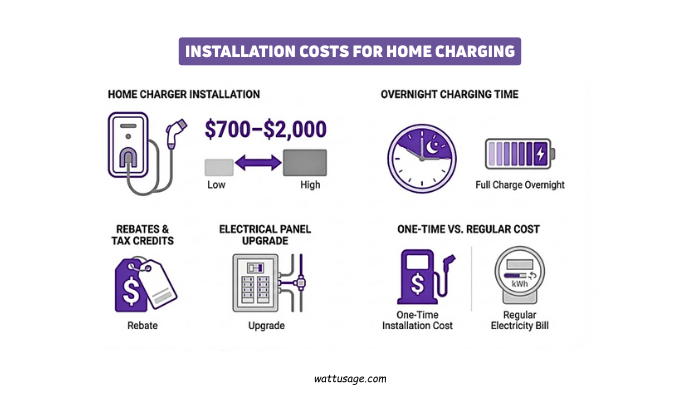
Charging at home costs more than just electricity.
Most EV owners install a dedicated home charger for faster, safer charging. Typical installation costs range from $700 to $2,000 in the U.S., including labor and equipment.
Some countries may offer rebates or tax credits for home charger installation.
Older homes might need electrical panel upgrades to support a high‑speed charger.
These costs are one‑time and are separate from your regular electricity bill.
Once installed, the home charger lets you plug in each night and wake up with a full battery.
Charging time varies, but most Level 2 chargers fill a typical EV overnight.
Comparing Home Charging With Public Charging
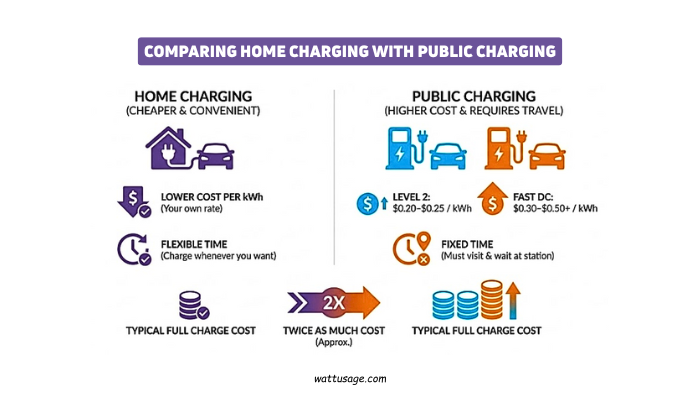
- Charging at home is usually much cheaper than public fast chargers.
- Public Level 2 chargers often cost $0.20–$0.25 per kWh, more than at home.
- Fast DC chargers at highways can cost $0.30–$0.50 per kWh or more.
That means a public full charge might cost twice as much as home charging.
Home charging also means you charge in your own time, without visiting outside stations.
Cost Per Mile vs Petrol Cars
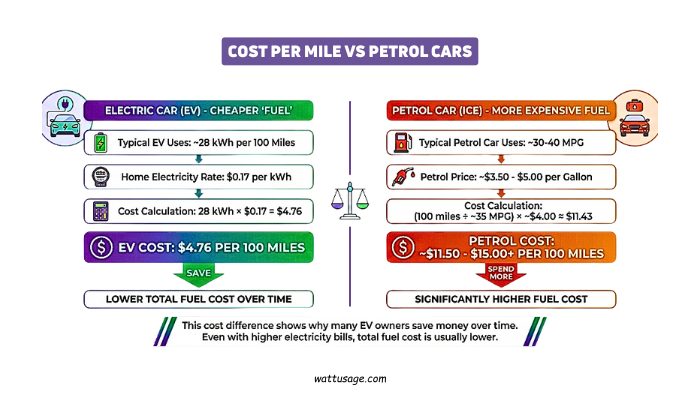
Electric cars are generally cheaper to “fuel” than petrol cars.
For example, a typical EV uses about 28 kWh per 100 miles.
At $0.17 per kWh, that’s $4.76 per 100 miles driven at home.
Compare that with petrol cars costing much more per 100 miles.
This cost difference shows why many EV owners save money over time.
Even with higher electricity bills, total fuel cost is usually lower.
Off‑Peak and Smart Charging Saves Money
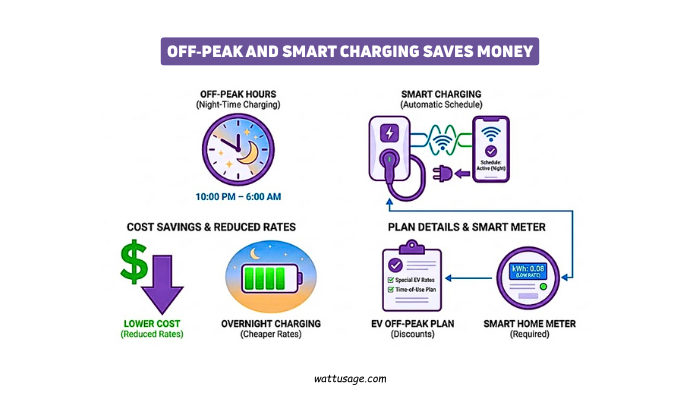
Many electricity plans have off‑peak hours at lower rates.
Charging overnight during cheaper hours cuts cost noticeably.
Smart chargers can schedule charging automatically at night.
Using off‑peak rates reduces the cost of charging electric car at home further.
Some plans even let EV owners charge at night for very low rates.
A smart home meter may be required for these plans.
Conclusion
The cost of charging electric car at home depends on battery size, electricity rate, and driving habits. Typical home charging costs range from $6–$20 per full charge at average residential rates. Daily driving may add only a few dollars to your monthly electricity bill. Installing a home charger has one‑time costs but improves convenience and speed. Charging at home is usually cheaper than public chargers and much cheaper than petrol or diesel.
F&Qs
Q1: Is home charging cheaper than public charging?
Yes, home charging costs less per kWh than most public chargers.
Q2: Does charging at night save money?
Yes, off‑peak electricity rates are lower, reducing cost.
Q3: How much does a home charger cost to install?
Installation ranges roughly $700–$2,000 before rebates.
Q4: Does driving distance affect cost?
Yes, more driving means more charging, which raises electricity costs.
Q5: Will my bill rise a lot?
It depends on usage and local electricity rates, but home charging is usually affordable.
