
When you first think about how much does it cost to charge an electric bike, you probably expect it to be high.
In truth, the cost is surprisingly low, even cheaper than most people imagine.
Electric bikes use small batteries and a bit of electricity, making them one of the most affordable transportation options.
Charging an e‑bike at home doesn’t add much to your electricity bill.
This is because e‑bike batteries are small compared to car batteries, and electricity use for bikes is minimal.
Basics of E‑Bike Charging Cost
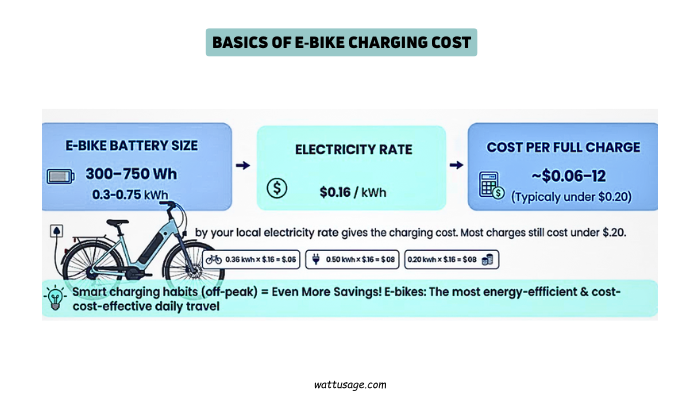
Electric bikes store energy in a battery measured in watt‑hours (Wh).
To understand cost, you convert that to kilowatt‑hours (kWh) because electricity is billed by kWh.
1,000 Wh = 1 kWh.
Most e‑bike batteries range between 300 Wh and 750 Wh (0.3–0.75 kWh).
Multiplying the battery size by your local electricity rate gives the charging cost of an electric bike.
For example, at $0.16 per kWh:
- 0.36 kWh battery × $0.16
~$0.06 per full charge - 0.50 kWh battery × $0.16
~$0.08 per full charge - 0.72 kWh battery × $0.16 ~ $0.12 per full charge
Even with electricity rates above average, most charges still cost under $0.20 per full charge.
Charging is simple, just plug the e‑bike into a regular home outlet with its charger.
How Often You Need to Charge
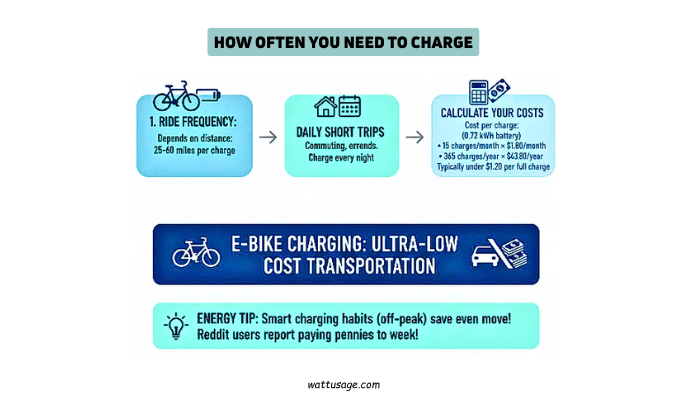
Your charging cost depends on how often you ride and how far you go.
A typical e‑bike can go 25–60 miles per full charge depending on motor assist level and terrain.
If you ride short distances daily (for school, work, or errands), you might charge every night.
In that case, you would multiply the cost per charge by the number of charges per month.
For example, with a 0.72 kWh battery that costs $0.12 per charge:
- 15 charges/month × $0.12 = $1.80 per month
- 365 charges/year × $0.12 = $43.80 per year
This is extremely low compared to petrol costs for scooters or cars.
Reddit users report similar findings, many pay almost nothing to charge their e‑bike battery each week, sometimes only a few cents.
Real‑World Charging Examples
Let’s break down typical battery sizes and costs:
| Battery Size | kWh | Approx. Cost per Full Charge |
|---|---|---|
| 250 Wh | 0.25 | ~$0.04 |
| 360 Wh | 0.36 | ~$0.06 |
| 500 Wh | 0.50 | ~$0.08 |
| 720 Wh | 0.72 | ~$0.12 |
| 1000 Wh | 1.00 | ~$0.16 |
These examples use a mid‑range electricity rate ($0.16/kWh), but costs scale with your local utility’s rate.
You rarely pay more than $0.20 per full charge, even with higher rates or larger batteries.
What Affects Your Charging Cost
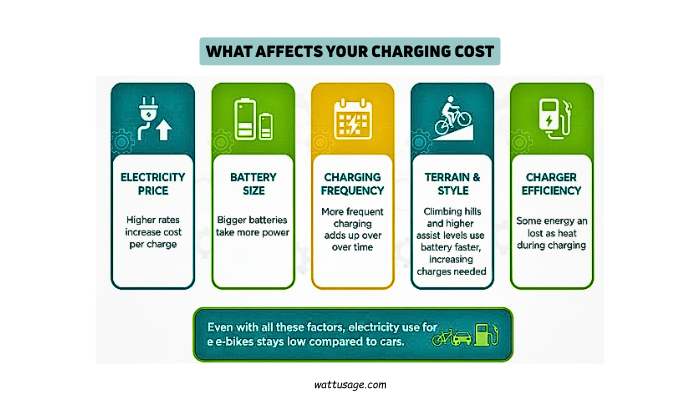
Several factors change how much you pay:
- Electricity price: Higher rates increase cost per charge.
- Battery size: Bigger batteries take more power.
- Charging frequency: More frequent charging adds up over time.
- Terrain & riding style: Climbing hills and higher assist levels use battery faster, increasing charges needed.
- Charger efficiency: Some energy is lost as heat during charging.
Even with all these factors, electricity use for e‑bikes stays low compared to cars.
Comparing E‑Bike Charging to Other Transportation
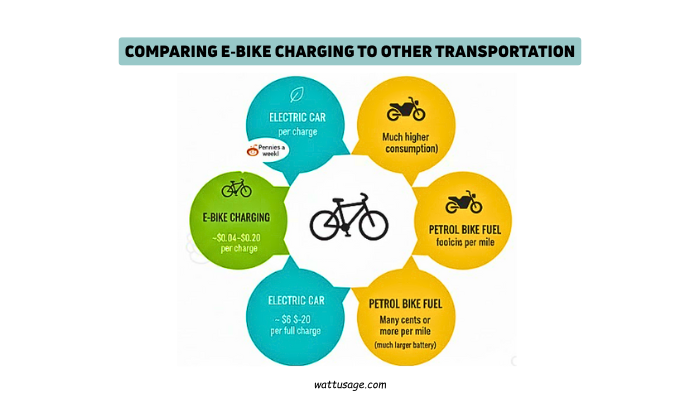
Charging an e‑bike costs far less than fueling motor scooters, petrol bikes, or cars.
One Reddit user noted that charging an e‑bike for daily commuting costs only pennies a week.
Per‑mile cost is tiny, often less than a cent per mile.
Car charging costs are higher (several dollars per full charge), and fuel costs for petrol cars are much more.
To illustrate:
- E‑bike charging: $0.04–$0.20 per charge, often <$2/month even with daily use.
- Electric car home charging: $6–$20 per full charge (much larger battery).
- Petrol bike: Fuel cost per mile can be many cents or more.
This shows how economical e‑bike charging is compared to larger vehicles.
Monthly and Annual Cost Estimates
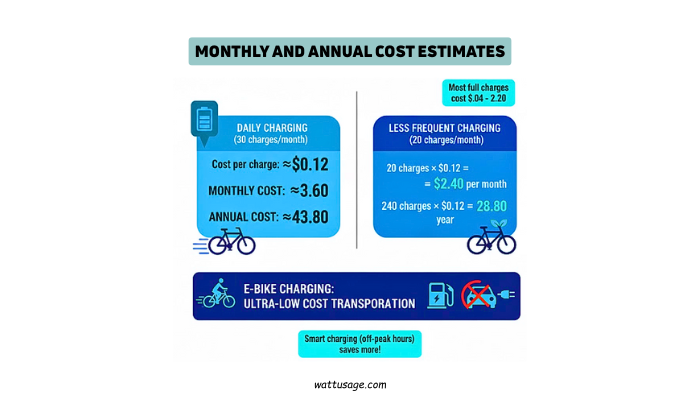
If you charge every day, your yearly cost can still be very low:
Using a typical 0.72 kWh battery:
- Cost per charge: $0.12
- Monthly cost: $3.60
- Annual cost: $43.80
Even if you ride less and charge only 20 times a month, costs stay low:
- 20 × $0.12 = $2.40 per month
- 240 × $0.12 = $28.80 per year
These figures show e‑bike charging does not meaningfully raise home electricity bills.
Charging an electric bike uses very little electricity, so the cost stays low.
Most full charges cost between $0.04 and $0.20 depending on battery size and electricity rate.
Daily riders might spend a few dollars per month, while annual cost usually stays less than $50.
Even with frequent use, e‑bike charging is much cheaper than car charging or petrol.
Smart charging habits and off‑peak hours make it even more affordable.
E‑bikes offer one of the most energy‑efficient and cost‑effective ways to travel daily.
Conclusion
Charging an electric bike at home is very cheap because e‑bike batteries are small and use minimal electricity.
Most batteries range from 0.3 kWh to 0.75 kWh, costing $0.04–$0.20 per full charge depending on local electricity rates.
Even daily use typically adds only a few dollars per month to your electricity bill, often under $50 annually.
Charging costs depend on battery size, electricity rates, riding frequency, terrain, and assist level.
Compared to electric cars or petrol vehicles, e‑bikes are extremely energy‑efficient and economical, with cost per mile usually less than a cent.
Simple practices like charging during off‑peak hours, only charging as needed, and maintaining the battery help reduce costs even further.
E‑bikes remain one of the most affordable, practical, and eco-friendly ways to commute or run errands, saving both money and energy.
FAQs
Q1: Does charging cost change by battery size?
Yes, bigger batteries cost more electricity per charge.
Q2: What is the typical cost per charge?
Most charges cost under $0.20 at home.
Q3: Can I lower charging costs?
Yes, charge during off‑peak rates and use only needed electricity.
Q4: Does riding style affect cost?
Yes, hilly roads or high assist use drain battery faster, increasing charges.
Q5: Is charging at home better than public stations?
Home charging is cheaper and more convenient for most riders.
