
When you wonder how much electricity does an air purifier use, you may worry about your electricity bill.
Most people think air purifiers run like heaters or air conditioners.
The truth is calmer and lighter: they usually consume much less power.Understanding electricity use helps you decide how often to run your purifier.
It also helps you balance clean air with a sensible electricity bill.
We will explore real data, real examples, and cost estimates for different models.
Basic Power Consumption of Air Purifiers
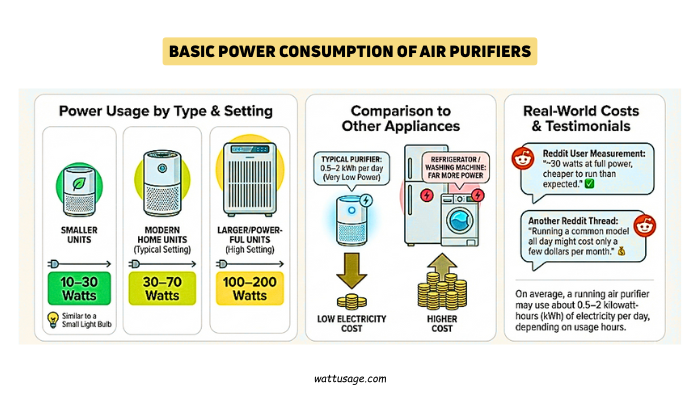
Air purifiers are designed to clean air without using a lot of electricity.
Most modern home air purifiers use between 30 and 70 watts on a typical setting.
Some smaller units use as little as 10–30 watts, similar to a small light bulb.
Larger or more powerful purifiers may use up to 100–200 watts on high settings.
To put that into perspective, a refrigerator or washing machine uses far more power than a typical purifier.
Because of this, purifiers usually have very low electricity cost compared with many common appliances.
On average, a running air purifier may use about 0.5–2 kilowatt‑hours (kWh) of electricity per day, depending on usage hours.
A Reddit user measured their air purifier at around 30 watts at full power and said it was cheaper to run than expected.
Another Reddit thread reported that running a common model all day might cost only a few dollars per month.
How Electricity Uses Works
Electricity use depends on two things:
- Wattage of the device (how much power it draws)
- Hours of operation (how long you run it each day)
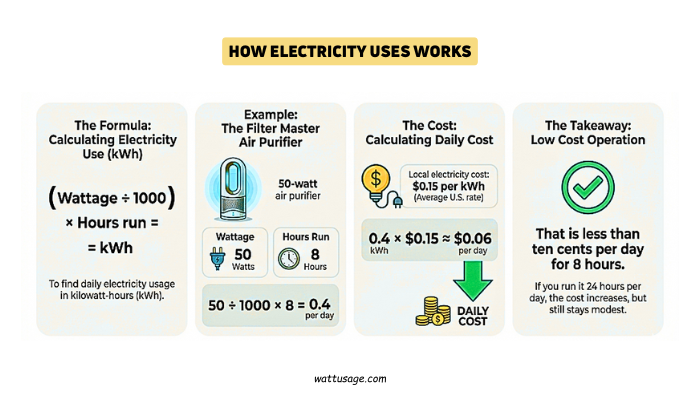
To find how much electricity it uses, you can use this simple formula:
Electricity use (kWh) = (Wattage ÷ 1000) × Hours run
For example, a 50‑watt air purifier running for 8 hours uses:
50 ÷ 1000 × 8 = 0.4 kWh per day.The Filter Master
If your local electricity cost is $0.15 per kWh (average U.S. rate), then:
0.4 × $0.15 ≈ $0.06 per day.The Filter Master
That is less than ten cents per day for running the purifier for 8 hours.
If you run it 24 hours per day, the cost increases, but still stays modest.
Daily, Monthly, and Annual Electricity Use
Let’s look at typical consumption and cost for common power levels:
| Wattage | Hours/Day | kWh/Day | Monthly kWh (30 days) | Monthly Cost ($0.15/kWh) |
|---|---|---|---|---|
| 25 W | 8 hrs | 0.20 | 6.0 | $0.90 |
| 50 W | 8 hrs | 0.40 | 12.0 | $1.80 |
| 75 W | 8 hrs | 0.60 | 18.0 | $2.70 |
| 100 W | 8 hrs | 0.80 | 24.0 | $3.60 |
| 50 W | 24 hrs | 1.20 | 36.0 | $5.40 |
These numbers show that even with daily 8‑hour use, most purifiers cost only $1–$4 monthly in electricity.
Running continuously for 24 hours raises the cost, but it still stays affordable for most people.
Reddit users often report that running their purifier day and night made only a modest increase in their bill.
They note that purifiers are more like a fan than a heater in terms of power draw.
What Affects Electricity Use Most
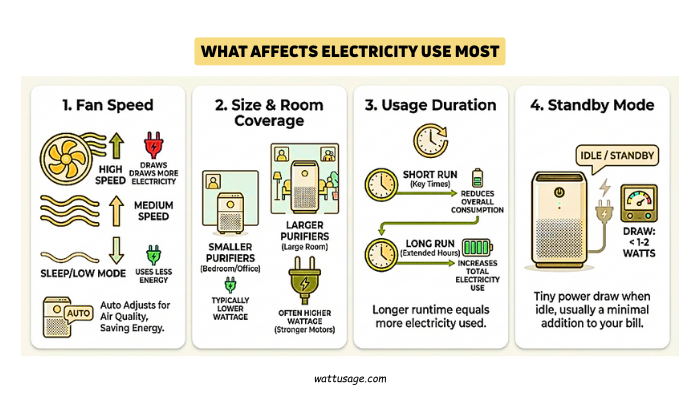
Even though purifiers use low power, several factors influence total consumption:
Fan Speed
Higher fan speeds draw more electricity, while sleep or low modes use less.
Many purifiers automatically adjust speed based on air quality, saving energy.
Size and Room Coverage
Larger room purifiers often need stronger motors and higher wattage.
Smaller purifiers for bedrooms or offices typically run at lower wattage.
Usage Duration
The longer you run the purifier, the more electricity it uses.
Running it only at key times can reduce the overall consumption.
Standby Mode
When idle, some models still draw small power (usually under 1–2 watts).
This standby consumption is tiny and usually not a big addition to your bill.
Comparing to Other Appliance Electricity Use
Compared with many household devices, air purifiers use very low electricity.
| Appliance | Typical Power | Annual Energy Use |
|---|---|---|
| Air Purifier | 30–100 W | 200–400 kWh |
| Refrigerator | 100–800 W | 600–1600 kWh |
| Television (LED) | 50–150 W | 100–300 kWh |
| Washing Machine | 500–1500 W | 300–500 kWh |
Air purifiers usually consume less energy than many common appliances.
This makes them a cost‑effective solution for cleaner indoor air.
Monthly Electricity Cost, a practical example:
Let’s say you run a 50‑watt purifier in your bedroom:
- 8 hours/day: 0.4 kWh/day
- 30 days: 12 kWh/month
- Electricity rate: $0.15 per kWh
- Monthly cost: $1.80
If you run a 75‑watt model more often:
- 10 hours/day: 0.75 kWh/day
- 30 days: 22.5 kWh/month
- Cost: $3.38/month
Even heavy use adds only a few dollars to most electricity bills.
A Reddit poster said that running a Coway purifier on high 24/7 for a month used about 50 kWh and cost roughly $8.32 at average U.S. rates.
This gives a real‑world comparison for 24/7 usage.
Tips to Reduce Electricity Use
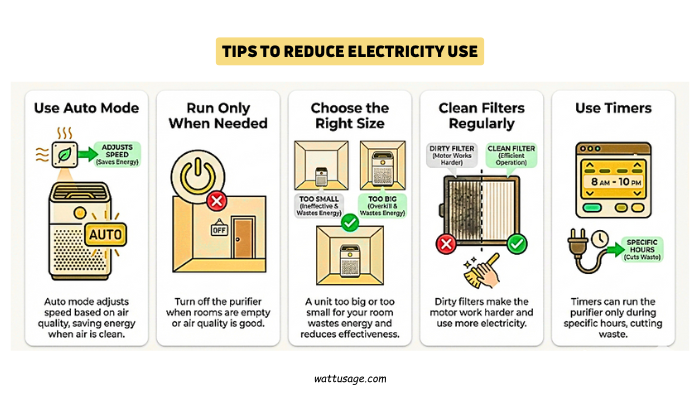
Even though purifiers consume low electricity, you can save more with good habits:
Use Auto Mode
Auto mode adjusts speed based on air quality, saving energy when air is clean.
Run Only When Needed
Turn off the purifier when rooms are empty or air quality is good.
Choose the Right Size
A unit too big or too small for your room wastes energy and reduces effectiveness.
Clean Filters Regularly
Dirty filters make the motor work harder and use more electricity.
Use Timers
Timers can run the purifier only during specific hours, cutting waste.
Conclusion
In most homes, air purifiers do not use much electricity.
Typical power consumption ranges from 10–200 watts depending on model and settings.
Daily usage often falls between 0.2–0.8 kWh, meaning only a few dollars per month.
Running a purifier 24/7 will cost more, but still much less than heaters or air conditioners.
With smart use and correct sizing, a purifier can clean air at very low energy cost.
Combining efficient use with good habits keeps both your indoor air and electricity bill balanced.
Air purifiers are thus an affordable and comfortable way to improve air quality without heavy electricity cost.
F&Qs
Q1: Does an air purifier increase my bill a lot?
No, most purifiers use about the same electricity as a light bulb.
Q2: Can I run it all day?
Yes, even 24/7 use usually costs only a small amount.
Q3: Do heavier filters use more power?
Sometimes, stronger motors for big filters may use slightly more.
Q4: Do sleep modes save electricity?
Yes, lower fan speeds use less power and still clean air.
Q5: Does size matter?
Yes, choosing the right size ensures efficiency and lower electricity use
