
How much electricity do window AC and portable AC units use is a question many homeowners quietly worry about.
Electricity bills often rise silently during summer, making cooling choices feel stressful and confusing. Air conditioners bring comfort, yet they also bring responsibility toward energy use.
Understanding electricity use helps you cool your space without fear or regret.
Both window AC and portable AC serve similar purposes, yet their power needs differ clearly.
Knowing these differences helps you choose wisely, not emotionally.
Understanding Electricity Use in Air Conditioners
Electricity use depends on cooling power, design, and daily usage habits.
Air conditioners convert electrical energy into cool air by removing heat from rooms.
Window AC units are installed directly into windows or walls.
Portable AC units sit inside rooms and vent hot air through hoses.
This design difference strongly affects electricity use.Window AC units release heat outside more efficiently. Portable AC units lose some cooling through exhaust hoses.
This loss increases electricity demand over time.
Most electricity consumption comes from compressors, fans, and motors.
The harder these parts work, the more power they consume.
Understanding this process helps explain why usage numbers differ.
How Much Electricity Does a Window AC Use
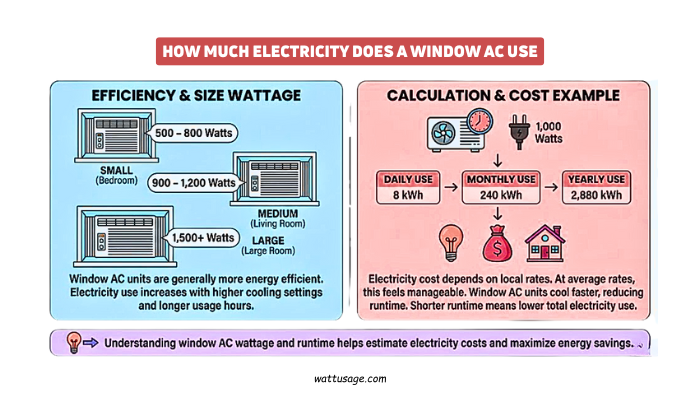
Window AC units are generally more energy efficient.
They usually consume between 500 and 1,500 watts, depending on size.
Small window AC units for bedrooms use around 500 to 800 watts.
Medium units for living rooms use 900 to 1,200 watts.
Large window AC units may reach 1,500 watts or more.
Electricity use increases with higher cooling settings and longer usage hours.
If a window AC runs eight hours daily at 1,000 watts:
Daily use equals 8 kWh.
Monthly use equals 240 kWh.
Yearly use reaches 2,880 kWh.
Electricity cost depends on local energy rates.
At average rates, this feels manageable for many households.
Window AC units cool faster, reducing runtime.
Shorter runtime means lower total electricity use.
How Much Electricity Does a Portable AC Use
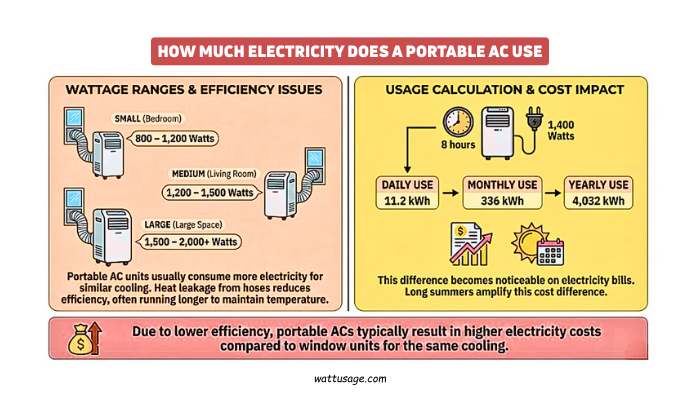
Portable AC units usually consume more electricity for similar cooling.
Most portable units use 800 to 2,000 watts.
Smaller portable AC units use around 800 to 1,200 watts.
Larger models reach 1,500 to 2,000 watts.
Portable units often run longer to maintain temperature.
Heat leakage from hoses reduces cooling efficiency.
If a portable AC runs eight hours daily at 1,400 watts:
Daily use equals 11.2 kWh.
Monthly use equals 336 kWh.
Yearly use reaches 4,032 kWh. This difference becomes noticeable on electricity bills. Long summers amplify this cost difference.
Why Portable AC Units Use More Electricity
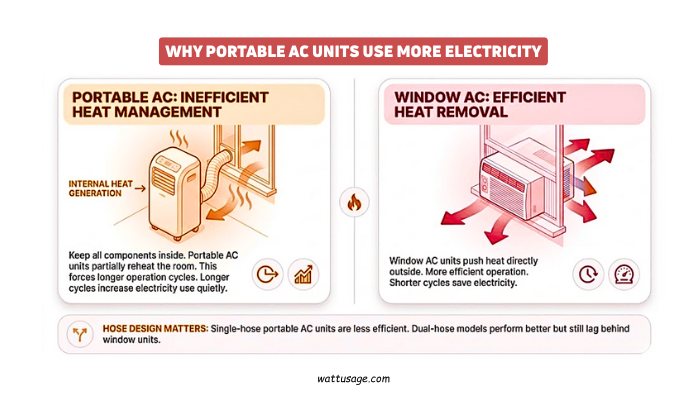
Portable AC units keep all components inside the room.
This includes compressors and heat-generating parts.
Window AC units push heat directly outside.
Portable AC units partially reheat the room.
This forces longer operation cycles.
Longer cycles increase electricity use quietly.
Single-hose portable AC units are less efficient.
Dual-hose models perform better but still lag behind window units.
Real-Life Usage Comparison
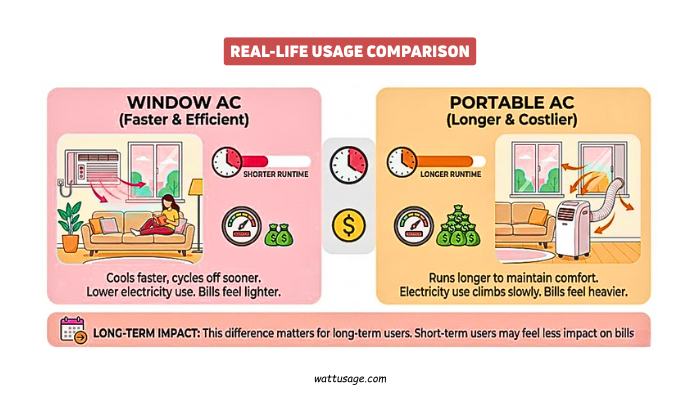
Consider a typical summer day.
Both units cool a medium-sized living room.
The window AC cools the room faster.
It cycles off sooner.
The portable AC runs longer to maintain comfort.
Electricity use slowly climbs.
Over one month, the difference becomes visible.
Bills feel heavier with portable units.
This difference matters for long-term users.
Short-term users may feel less impact.
Cost Comparison Table
| AC Type | Average Watts | Daily Use (8 hrs) | Monthly kWh | Approx Monthly Cost |
| Window AC | 1,000 W | 8 kWh | 240 kWh | Lower |
| Portable AC | 1,400 W | 11.2 kWh | 336 kWh | Higher |
Portable AC units typically cost 30–40% more to run monthly.
When Portable AC Makes Sense
Portable AC units offer flexibility.
They work well for renters and temporary spaces.
They suit rooms without window installation options.
Short-term use reduces cost impact.
For occasional cooling, portability feels worth the trade-off.
When Window AC Is the Better Choice
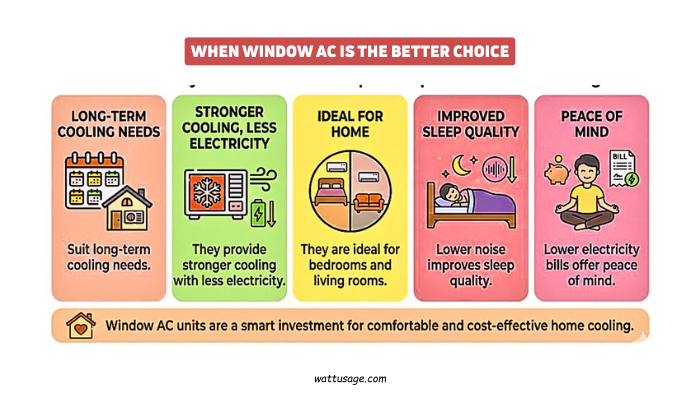
Window AC units suit long-term cooling needs.
They provide stronger cooling with less electricity.
They are ideal for bedrooms and living rooms.
Lower noise improves sleep quality.
Lower electricity bills offer peace of mind.
Conclusion
How Much Electricity Do Window AC and Portable AC Use depends on design, efficiency, and usage habits.
Window AC units generally use less electricity for the same cooling output.
Portable AC units offer flexibility but consume more power.
Longer runtimes increase monthly electricity costs.
Choosing the right unit balances comfort, cost, and lifestyle needs.
Awareness brings calm, not confusion.
FAQs
Q1: Which AC type uses less electricity overall?
Window AC units usually consume less electricity.
Q2: Are portable AC units always inefficient?
They are less efficient, but useful in certain situations.
Q3: Does room size affect electricity use?
Yes, larger rooms require more power.
Q4: Can dual-hose portable AC units save electricity?
They perform better but still use more power than window units.
Q5: Which option is better for long summers?
Window AC units are more economical for long-term use.
Want to save on your summer bills? See how much electricity a fan uses and compare with your AC! Click Here
