
Raspberry pi power consumption often surprises people when they first meet this tiny computer.
Raspberry pi power consumption feels small, gentle, and almost thoughtful compared to larger machines.
This guide explores raspberry pi power consumption calmly, without fear, confusion, or heavy technical language. Many people worry about electricity bills before starting projects.
Understanding power use helps ideas grow without stress.
Understanding Raspberry Pi Power Consumption
Raspberry pi power consumption depends on the model, workload, and connected devices.
Each Raspberry Pi behaves differently under real use.
Older models consume less power but also perform slower tasks. Newer models consume more power yet finish work faster. Raspberry pi power consumption usually ranges between two and eight watts.
This number changes with screen brightness, processor load, and accessories. A simple project uses far less electricity than gaming or video streaming. This balance makes Raspberry Pi ideal for learning and experiments.
Raspberry Pi Models and Power Differences
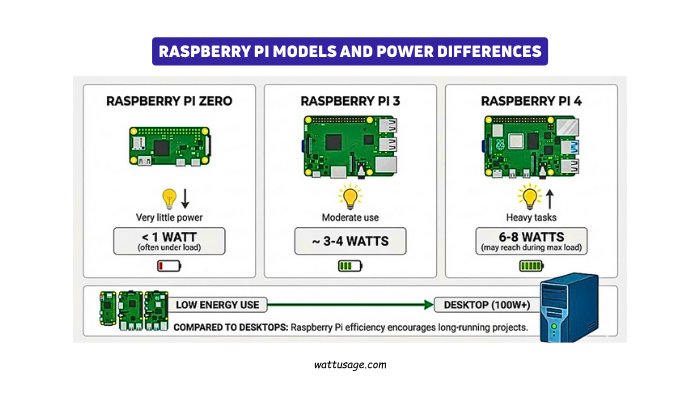
- Raspberry pi power consumption changes across different versions.
- Raspberry Pi Zero uses very little power, often under one watt.
- Raspberry Pi 3 uses around three to four watts under moderate use.
- Raspberry Pi 4 may reach six to eight watts during heavy tasks.
Even at maximum load, energy use remains low. Compared to desktop computers, Raspberry Pi feels almost silent electrically. This efficiency encourages long-running projects.
What Increases Raspberry Pi Power Consumption
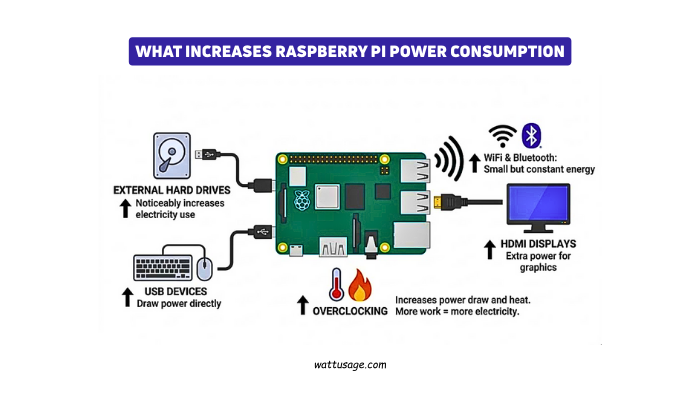
Raspberry pi power consumption increases with added accessories. USB devices draw power directly from the board.
External hard drives increase electricity use noticeably. HDMI displays require extra power for graphics processing. WiFi and Bluetooth add small but constant energy needs.
Overclocking also increases power draw and heat. More work means more electricity, just like human effort.
Idle vs Active Power Usage
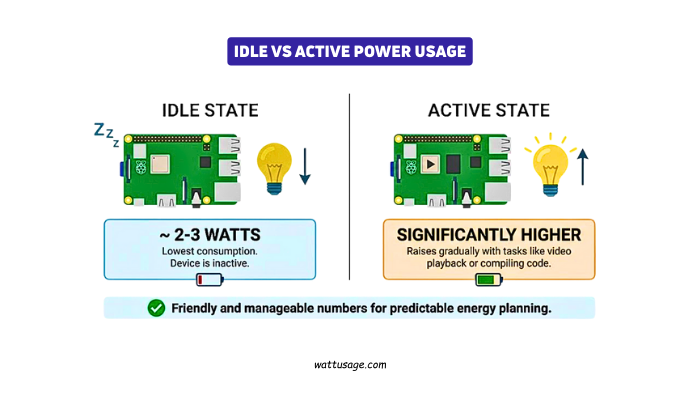
Raspberry pi power consumption stays lowest during idle states. Idle usage often stays between two and three watts.
Active tasks raise consumption gradually. Video playback or compiling code raises usage significantly. Still, the numbers remain friendly and manageable. This predictability helps planning energy costs.
Raspberry pi power consumption stays lowest during idle states. Idle usage often stays between two and three watts.
Active tasks raise consumption gradually. Video playback or compiling code raises usage significantly. Still, the numbers remain friendly and manageable. This predictability helps planning energy costs.
Daily, Monthly, and Yearly Energy Cost
Raspberry pi power consumption becomes clearer when measured over time.
- A device using five watts continuously consumes 0.12 kWh daily.
- Monthly usage reaches around 3.6 kWh.
- Yearly usage stays near 43 kWh.
At average rates, costs remain very low. Many users spend less than coffee money annually.
Raspberry Pi Power Consumption Table
| Raspberry Pi Model | Average Watts | Daily kWh | Monthly kWh | Yearly kWh |
|---|---|---|---|---|
| Pi Zero | 0.8 W | 0.02 | 0.6 | 7.3 |
| Pi 3 | 3.5 W | 0.08 | 2.5 | 30 |
| Pi 4 | 6.5 W | 0.16 | 4.8 | 58 |
Numbers vary depending on usage patterns.
Why Raspberry Pi Is Energy Friendly
Raspberry pi power consumption stays low because hardware stays simple. ARM processors focus on efficiency rather than raw power.
No spinning parts reduce wasted energy. Small form design prevents unnecessary heat loss.
Efficiency becomes a quiet philosophy here.
Raspberry Pi vs Desktop Computers
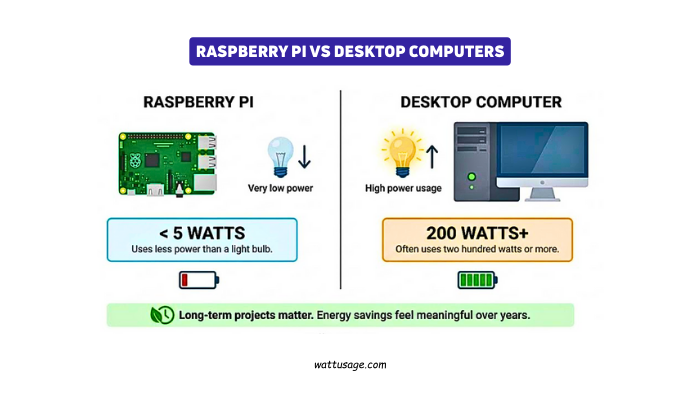
Raspberry pi power consumption looks tiny beside desktop systems. Desktops often use two hundred watts or more. Raspberry Pi uses less power than a light bulb.
This difference matters for long-term projects. Energy savings feel meaningful over years.
Real Life Use Cases
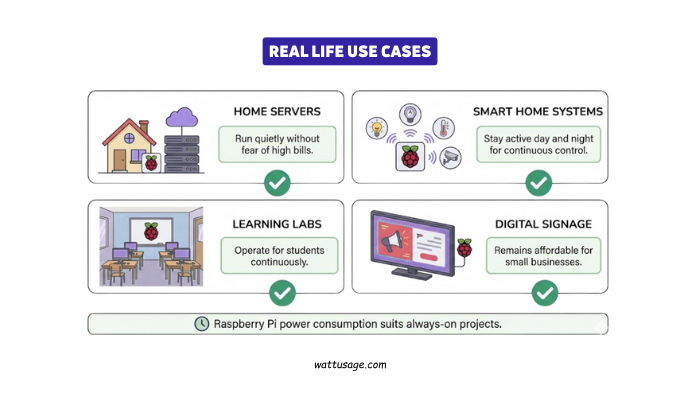
Raspberry pi power consumption suits always-on projects. Home servers run quietly without fear of high bills.
Smart home systems stay active day and night. Learning labs operate for students continuously.
Digital signage remains affordable for small businesses.
Emotional Reflection on Power and Simplicity
Raspberry pi power consumption teaches restraint and intention. It reminds us that progress does not require excess.
Small machines can carry big ideas. Energy becomes a companion, not a burden.
This quiet efficiency feels comforting.
Tips to Reduce Raspberry Pi Power Consumption
Raspberry pi power consumption reduces with mindful choices.
Disable unused services. Remove unused USB devices. Lower screen brightness. Avoid unnecessary overclocking. Use efficient power supplies.
Small steps create lasting savings.
Safety and Power Supply Choices
Raspberry pi power consumption depends on stable voltage. Poor power supplies waste energy.
Quality adapters protect both board and data. Stable power improves long-term reliability. Safety always supports efficiency.
Conclusion
Raspberry pi power consumption stays gentle, predictable, and forgiving. It supports creativity without draining resources.
This small board proves that computing does not need excess. Efficiency, patience, and intention shape better technology habits.
Raspberry Pi quietly teaches us balance.
FAQs
Q1: Does Raspberry Pi consume power when idle?
Yes, idle consumption remains low but never reaches zero.
Q2: Can Raspberry Pi run all day safely?
Yes, continuous operation is common and safe.
Q3: Is Raspberry Pi cheaper than a laptop?
Yes, energy use stays dramatically lower.
Q4: Does adding accessories increase power use?
Yes, each device adds small power demands.
Q5: Is Raspberry Pi eco-friendly?
Yes, its low power usage supports sustainable computing.
Curious about the hidden glow of energy? Read our article: What Color Is Electricity?
