
How Many Watts Does A Hair Dryer Use is a question people rarely ask directly.
Hair dryers feel harmless, yet they pull strong power in short bursts.
Understanding this helps us respect electricity without fear.
A hair dryer stays silent most of the day. Yet when switched on, it becomes one of the strongest household tools. This contrast makes it worth understanding calmly.
Electricity use is not only about time. It is also about intensity and purpose. Hair dryers teach this lesson quietly.
Understanding Hair Dryer Power Consumption
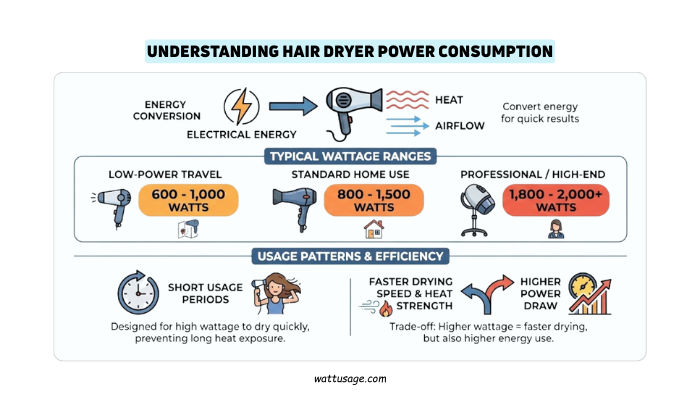
Hair dryers convert electrical energy into heat and airflow. This process requires strong power for quick results.
Most hair dryers are designed for short usage periods. They use high wattage to dry hair quickly.
This design prevents long exposure to heat. It also limits extended electricity consumption.
Hair dryers usually consume between 800 and 2,000 watts. Some professional models exceed 2,000 watts.
Low-power travel dryers may use 600 to 1,000 watts. High-end salon dryers often reach maximum wattage.
Wattage determines drying speed and heat strength. Higher wattage means faster drying.
However, faster drying also means higher power draw. This trade-off defines hair dryer energy use.
What Affects Hair Dryer Electricity Usage
Electricity usage depends on several quiet factors.
The wattage rating matters most. Higher wattage pulls more electricity instantly.
The heat setting affects power draw. High heat uses more energy than warm air. The speed setting also matters. Higher airflow consumes additional power.
Usage duration changes total consumption. Long styling sessions increase electricity use.
Hair length and thickness influence drying time. Thicker hair demands more energy.
Environmental humidity affects drying efficiency. Humid air slows drying and increases usage.
Older hair dryers are less efficient. Newer models distribute heat better.
Technology improves efficiency quietly over time. This reduces wasted electricity.
Daily, Monthly, and Yearly Electricity Use
Hair dryers use strong power briefly.
This keeps overall energy use lower than expected.
Example:
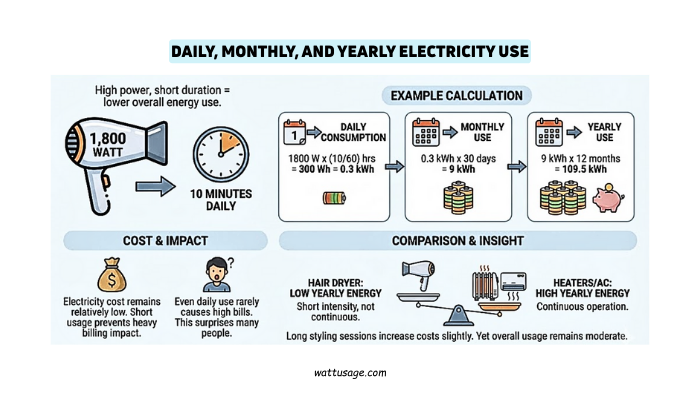
A 1,800-watt hair dryer used for 10 minutes daily.
- Daily consumption equals 0.3 kWh.
- Monthly use equals 9 kWh.
- Yearly use equals 109.5 kWh.
Electricity cost remains relatively low. Short usage prevents heavy billing impact.
Even daily use rarely causes high bills. This surprises many people.
Long styling sessions increase costs slightly. Yet overall usage remains moderate.
Compared to heaters or air conditioners, hair dryers consume less energy yearly. Their intensity is short, not continuous.
Professional vs Home Hair Dryers
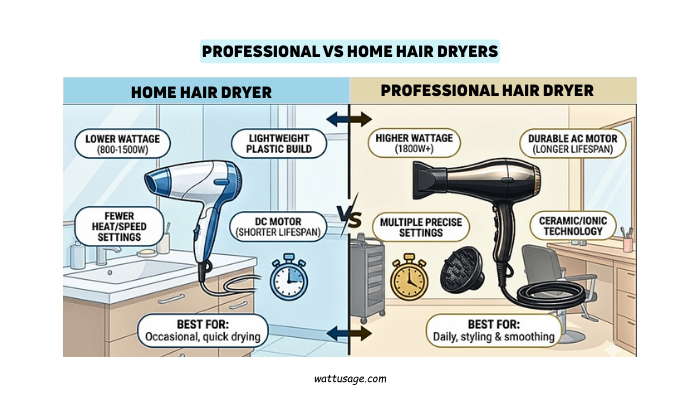
Professional hair dryers use higher wattage. They are designed for speed and durability.
Salon use involves repeated short sessions. High wattage supports efficiency in busy environments.
Home hair dryers focus on comfort and safety. They balance power with ease of use.
Professional models may consume more electricity per session. However, sessions are often shorter.
Home dryers may run longer. Lower wattage balances this difference.
Choice depends on usage frequency and hair needs. There is no universal best option.
Hair Dryer Wattage Comparison Table
| Hair Dryer Type | Average Watts | Daily Use | Monthly kWh | Cost Impact |
|---|---|---|---|---|
| Travel Dryer | 800 W | 10 min | 4 kWh | Very Low |
| Standard Home Dryer | 1,500 W | 10 min | 7.5 kWh | Low |
| High-Power Dryer | 1,800 W | 10 min | 9 kWh | Moderate |
| Professional Dryer | 2,200 W | 10 min | 11 kWh | Moderate |
Electricity costs remain manageable for all types. Usage habits matter more than wattage alone.
Energy Efficiency and Hair Health
Efficient hair dryers dry hair faster. Shorter drying means less electricity use.
Modern dryers use ionic or ceramic technology. These features reduce heat damage. Lower heat settings protect hair health. They also reduce power draw.
Using a towel before drying saves energy. It shortens drying time naturally.
Energy awareness aligns with self-care. Both begin with patience.
Common Myths About Hair Dryer Electricity Use
Many believe hair dryers drastically increase electricity bills. This belief is mostly exaggerated.
Hair dryers use high power briefly. They do not run for hours.
Another myth involves low-wattage safety. Lower wattage does not always mean better efficiency.
Efficiency depends on drying time. Fast drying can save energy. Understanding truth removes unnecessary worry.
Clarity replaces fear.
Environmental Impact of Hair Dryers
Hair dryers contribute small amounts to household energy use.
Their environmental impact is limited. Mindful usage still matters.
Every habit shapes collective energy demand.
Efficient dryers reduce unnecessary heat loss. Responsible use supports sustainability.
Simple choices matter more than perfection. Awareness leads gently to balance.
Conclusion
How Many Watts Does A Hair Dryer Use depends on wattage, settings, and usage time.
Most hair dryers consume between 800 and 2,000 watts during operation.
Short usage keeps electricity costs low. Daily drying rarely impacts bills significantly.
Efficient habits reduce energy use naturally. Understanding brings calm control, not restriction.
Electricity becomes a tool, not a burden.
FAQs
Q1: Do hair dryers consume electricity when off?
No, they consume power only during use.
Q2: Is higher wattage always worse?
No, faster drying can reduce total energy use.
Q3: Can a hair dryer overload a socket?
Yes, avoid using it with other heavy appliances.
Q4: Are modern dryers more efficient?
Yes, newer designs distribute heat better.
Q5: Does cold air mode save electricity?
Yes, it uses less power than heat modes.
