When you wonder How Many Watts Does a Kettle Use, electricity bills and energy efficiency often come to mind.
The answer depends on kettle type, capacity, and frequency of use.
Understanding kettle wattage helps plan electricity costs while making your daily tea or coffee without waste.
Modern kettles are designed to heat water quickly while using electricity efficiently.
From basic stove top kettles to advanced electric kettles with auto-shutoff, power consumption varies.
Types of Kettles and Their Wattage
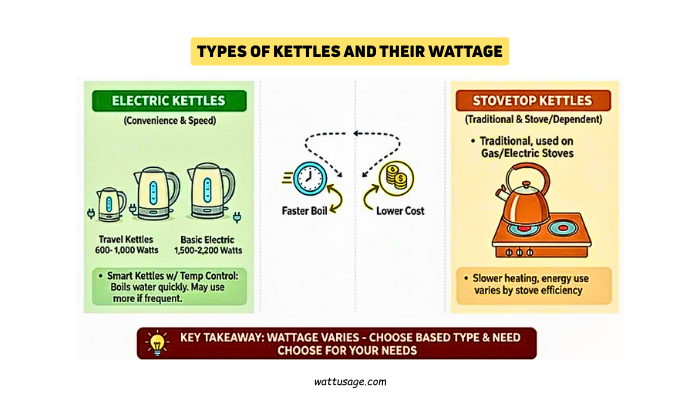
How Many Watts Does a Kettle Use depends on type and model:
- Stovetop kettles: Traditional, used on gas or electric stoves; electricity use depends on stove wattage, usually 1,200–2,500 watts for electric stoves.
- Basic electric kettles: Household models typically use 1,500–2,200 watts.
- High-capacity electric kettles: 2,200–3,000 watts, designed to boil more water quickly.
- Travel kettles: Compact, 600–1,000 watts, ideal for small quantities.
- Smart kettles with temperature control: 1,500–2,200 watts, offer precise heating and auto-shutoff for safety.
Higher wattage kettles boil water faster but may consume more electricity if used frequently.
Lower wattage kettles are slower but use less energy per session.
How Daily and Monthly Electricity Use Adds Up
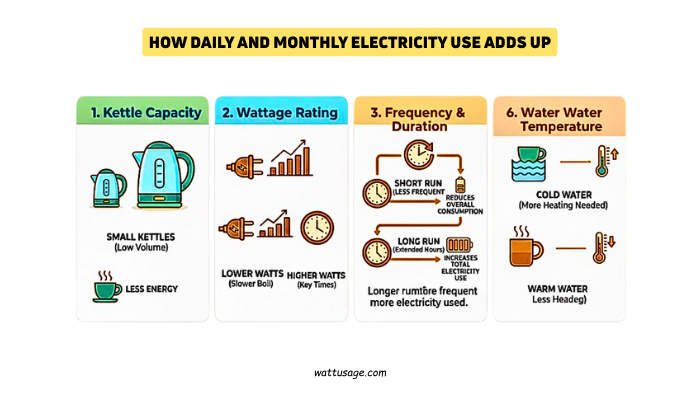
Electricity consumption depends on kettle wattage and boiling duration.
1,500-watt kettle boiling 1 liter for 5 minutes/day
- 1,500 W × 0.083 hr (5 min) ≈ 0.125 kWh/day
- Monthly: 0.125 × 30 ≈ 3.75 kWh
- Yearly: 0.125 × 365 ≈ 45.6 kWh
High-capacity 2,500-watt kettle boiling 2 liters for 10 minutes/day
- 2,500 W × 0.167 hr (10 min) ≈ 0.417 kWh/day
- Monthly: 12.5 kWh
- Yearly: 152.2 kWh
At $0.15 per kWh:
- Small kettle monthly = $0.56, yearly = $6.84
- High-capacity kettle monthly = $1.88, yearly = $22.83
Even frequent kettle use consumes less electricity than larger appliances like irons or stoves.
Several factors influence how much electricity a kettle uses:
- Kettle capacity: Larger kettles need more energy to heat more water.
- Wattage rating: Higher wattage heats water faster but uses more power.
- Boiling duration: Longer boiling increases total electricity use.
- Frequency of use: Multiple boils per day add up.
- Water temperature: Starting with cold water uses more electricity than warm water.
- Insulation and design: Well-insulated kettles retain heat and reduce energy waste.
Small adjustments, like boiling only the water you need, reduce energy consumption.
Understanding How Many Watts Does a Kettle Use helps select the best kettle for daily needs.
Kettle Wattage Comparison Table
| Kettle Type | Typical Wattage | Boiling Duration | Daily kWh | Monthly kWh | Annual Cost ($) |
|---|---|---|---|---|---|
| Travel Kettle | 600–1,000 W | 5 min | 0.05–0.08 kWh | 1.5–2.4 kWh | 0.23–0.36 |
| Basic Electric | 1,500 W | 5 min | 0.125 kWh | 3.75 kWh | 0.56 |
| High-Capacity | 2,500 W | 10 min | 0.417 kWh | 12.5 kWh | 1.88 |
| Smart Temperature-Control | 1,500–2,200 W | 5–7 min | 0.125–0.257 kWh | 3.75–7.7 kWh | 0.56–1.16 |
A family using a kettle multiple times a day:
- Breakfast tea: 1,500 W × 5 min = 0.125 kWh
- Mid-morning coffee: 1,500 W × 5 min = 0.125 kWh
- Afternoon tea: 1,500 W × 5 min = 0.125 kWh
- Evening tea: 1,500 W × 5 min = 0.125 kWh
Daily total: 0.125 × 4 = 0.5 kWh
Monthly: 0.5 × 30 = 15 kWh
Yearly: 0.5 × 365 = 182.5 kWh
At $0.15/kWh, monthly cost ≈ $2.25, yearly ≈ $27.38.
Even frequent daily use remains low in electricity consumption.
Tips to Reduce Electricity Use
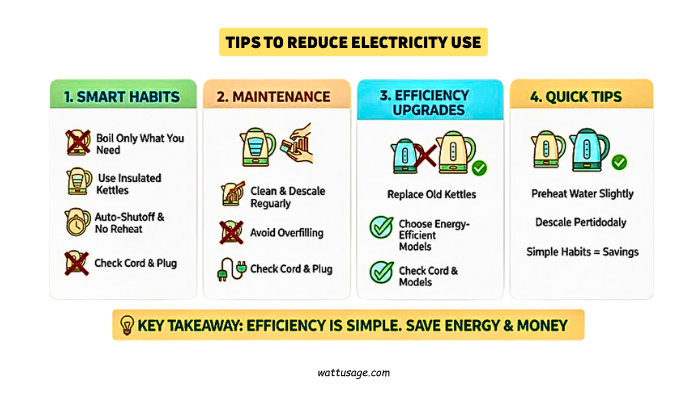
- Boil only the water you need, avoiding unnecessary energy use.
- Use well-insulated kettles to keep water warm longer.
- Avoid repeated reheating; pour only the required amount.
- Use the kettle’s auto-shutoff function to prevent energy waste.
- Preheat water slightly if using cold water multiple times.
Simple habits can make kettles extremely energy-efficient without affecting convenience.
Maintenance and Efficiency
- Clean kettle interior regularly to prevent scale buildup, which reduces heating efficiency.
- Descale the kettle periodically for smooth operation.
- Avoid overfilling; boil only the required amount of water.
- Ensure cord and plug are in good condition for safe operation.
- Replace old kettles with energy-efficient models for faster, less wasteful heating.
Proper maintenance keeps kettles operating efficiently, saving both electricity and time.
Stovetop vs Electric Kettles
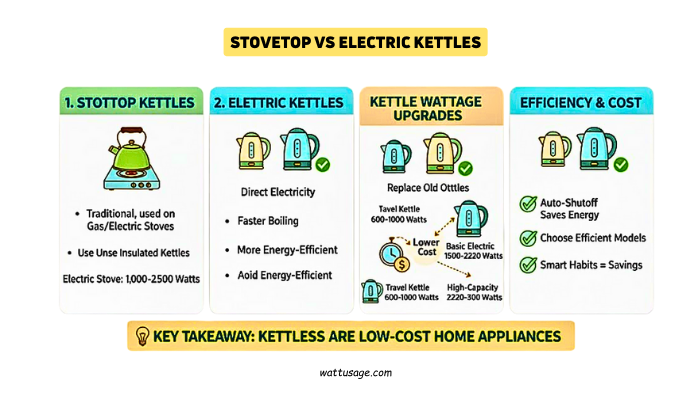
- Stovetop kettles: Electricity consumption depends on stove wattage (1,200–2,500 W for electric stoves).
- Electric kettles: Direct electricity use, faster boiling, often more energy-efficient.
- Travel kettles: Use less electricity but are slower for large quantities.
Electric kettles generally provide faster, more predictable boiling with less wasted energy.
Kettles draw 600–3,000 watts depending on type, capacity, and features.
Daily and monthly electricity use depends on how often and how much water you boil.
Energy-efficient kettles, auto-shutoff, and smart boiling habits reduce electricity bills.
Even frequent kettle use remains one of the least expensive ways to use electricity at home.
Understanding How Many Watts Does a Kettle Use helps choose the right kettle and save energy.
F&Qs
Q1: Do all kettles use the same electricity?
No, larger capacity or higher wattage kettles consume more electricity.
Q2: Does boiling more water use significantly more electricity?
Yes, heating more water increases energy consumption proportionally.
Q3: Are travel kettles more efficient?
Yes, smaller capacity and lower wattage consume less electricity for small amounts.
Q4: Can I save electricity by not using the kettle frequently?
Absolutely, only boiling what you need reduces daily consumption.
Q5: Do electric kettles heat water faster than stovetop kettles?
Yes, electric kettles convert electricity directly into heat efficiently.
