
When you wonder How Many Watts Does a Water Pump Use, electricity costs often come to mind. The power requirement of a pump depends on its type, size, and how long it operates daily.
Understanding water pump wattage helps plan energy costs while ensuring efficient water supply at home or work.
Modern pumps are designed to deliver water efficiently while using electricity smartly. From small submersible pumps to large surface pumps, energy consumption can vary significantly.
Types of Water Pumps and Typical Wattage
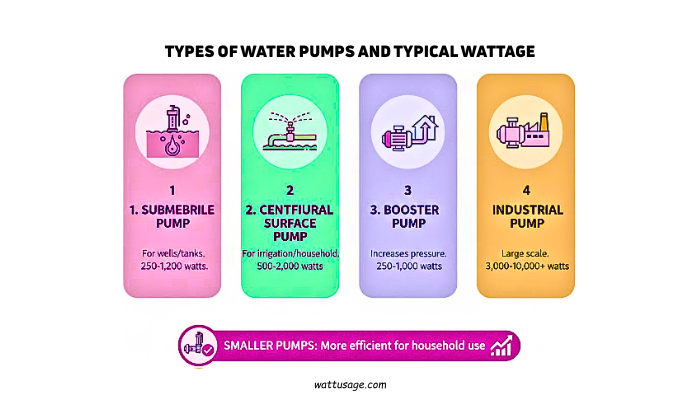
Water pumps are not all the same; electricity use depends on type and size:
- Submersible pumps: Common for wells or tanks; typically 250–1,200 watts for small domestic models.
- Centrifugal surface pumps: Used for irrigation or household water supply; 500–2,000 watts per pump.
- Booster pumps: Increase water pressure; usually 250–1,000 watts.
- Large industrial pumps: Can reach 3,000–10,000 watts or more, depending on flow rate.
Smaller pumps are more energy-efficient and suitable for household use.
Larger pumps handle more water but consume more electricity.
Efficiency depends not just on wattage but also on pump design and usage habits.
How Daily and Monthly Electricity Use Adds Up
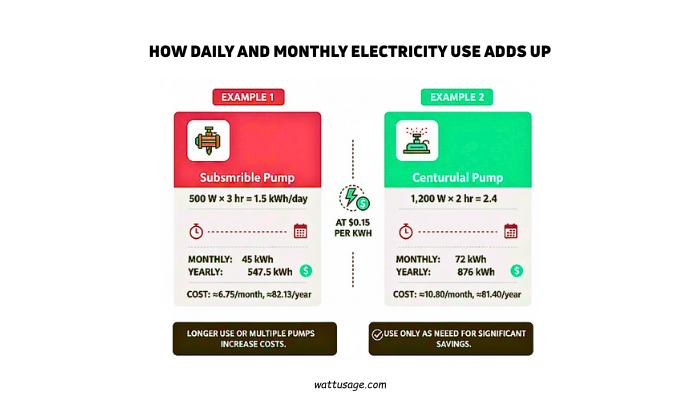
Calculating water pump energy use is simple: multiply wattage by operating hours.
Example 1: 500-watt submersible pump running 3 hours/day
- 500 W × 3 hr = 1.5 kWh/day
- Monthly: 1.5 × 30 = 45 kWh
- Yearly: 1.5 × 365 = 547.5 kWh
Example 2: 1,200-watt centrifugal pump running 2 hours/day
- 1,200 W × 2 hr = 2.4 kWh/day
- Monthly: 72 kWh
- Yearly: 876 kWh
At $0.15 per kWh:
- Submersible pump monthly ≈ $6.75, yearly ≈ $82.13
- Centrifugal pump monthly ≈ $10.80, yearly ≈ $131.40
Longer operating hours or multiple pumps increase energy costs.
Using pumps only when needed can significantly reduce electricity consumption.
Factors Affecting Electricity Use
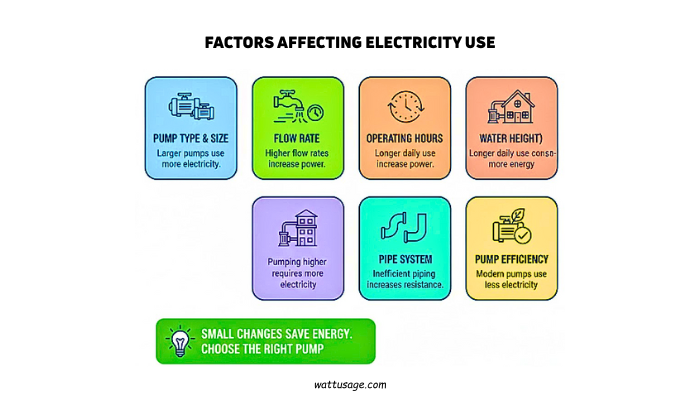
Several factors influence how much electricity a water pump consumes:
- Pump type and size: Larger pumps use more electricity.
- Flow rate: Higher flow rates increase power usage.
- Operating hours: Longer daily operation consumes more energy.
- Water height (head): Pumping water higher requires more electricity.
- Pipe diameter and length: Inefficient piping increases resistance, raising energy use.
- Pump efficiency rating: Modern pumps are designed to use less electricity for the same output.
Even small changes, like reducing unnecessary operating hours or optimizing pipe layout, save energy.
Understanding How Many Watts Does a Water Pump Use helps choose the right pump for your needs.
Water Pump Wattage Comparison Table
| Pump Type | Typical Wattage | Daily Use | Monthly kWh | Annual Cost ($) |
|---|---|---|---|---|
| Small Submersible | 250–500 W | 1.25 kWh | 37.5 kWh | 5.63 |
| Medium Submersible | 1,000 W | 3 kWh | 90 kWh | 13.50 |
| Centrifugal Surface | 500–1,200 W | 2.4 kWh | 72 kWh | 10.80 |
| Booster Pump | 250–1,000 W | 1.5 kWh | 45 kWh | 6.75 |
| Large Industrial | 3,000–10,000 W | 10 kWh | 300 kWh | 45.00 |
This table shows how different pump types and wattage affect electricity use and cost.
Real-Life Household Example
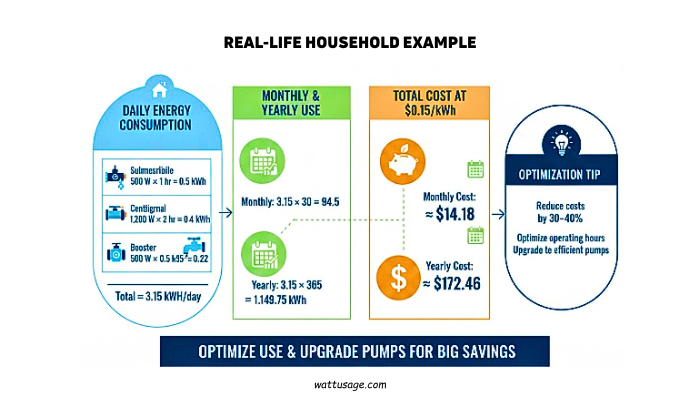
Imagine a home using a water pump daily for:
- Tank filling: 1 submersible pump, 1 hour
- Garden irrigation: centrifugal pump, 2 hours
- Booster pump for water pressure: 0.5 hour
Daily energy consumption:
- Submersible: 500 W × 1 hr = 0.5 kWh
- Centrifugal: 1,200 W × 2 hr = 2.4 kWh
- Booster: 500 W × 0.5 hr = 0.25 kWh
- Total = 3.15 kWh/day
Monthly: 3.15 × 30 ≈ 94.5 kWh
Yearly: 3.15 × 365 ≈ 1,149.75 kWh
At $0.15/kWh, total monthly cost ≈ $14.18, yearly ≈ $172.46.
Optimizing operating hours or switching to efficient pumps could reduce costs by 30–40%.
Tips to Reduce Electricity Use
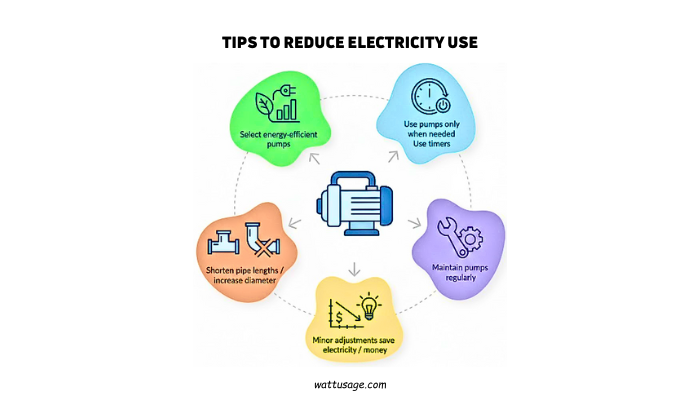
- Select energy-efficient pumps with good efficiency ratings.
- Use pumps only when water is needed; avoid running continuously.
- Shorten pipe lengths or increase diameter to reduce energy loss.
- Use timers or float switches to automatically control operation.
- Maintain pumps regularly to ensure smooth operation.
Even minor adjustments like reducing operating hours can save significant electricity over time.
Environmental Considerations
Water pumps consume electricity and contribute to carbon emissions if the power comes from fossil fuels. Using efficient pumps and optimizing usage lowers electricity bills and reduces environmental impact.
Smaller pumps for household use are more sustainable than running oversized industrial models unnecessarily.
Using automated timers and proper maintenance ensures efficient energy use without waste.
Maintenance and Efficiency
- Clean pump filters and impellers regularly to prevent energy loss.
- Check for leaks or blockages in pipes that increase pump load.
- Replace old pumps with energy-efficient models.
- Regularly inspect electrical connections for optimal performance.
Efficient maintenance ensures pumps draw only the necessary electricity.
Industrial vs Home Pumps
Industrial water pumps often use 3,000–10,000 watts or more for large-scale water movement.
Home pumps are smaller, typically 250–1,200 watts per pump.
Even frequent household use consumes manageable electricity compared to industrial setups.
Planning operating hours and choosing the right pump ensures optimal energy use.
Conclusion
Water pumps draw 250–1,200 watts for household use, depending on type and size. Industrial pumps may use 3,000–10,000 watts or more.
Daily and monthly electricity use depends on operating hours, pump type, and water flow requirements.
Timers, efficient pumps, and proper maintenance reduce electricity consumption and costs.
Understanding pump wattage empowers households and businesses to manage energy use efficiently.
F&Qs
Q1: Do all water pumps use the same electricity?
No, larger pumps or higher flow rate models consume more electricity.
Q2: Can a booster pump save energy?
Yes, it provides pressure only when needed, reducing continuous power use.
Q3: How do I calculate my pump’s electricity cost?
Multiply pump wattage by operating hours to get daily kWh, then calculate monthly or yearly cost.
Q4: Does pipe layout affect electricity use?
Absolutely, shorter, wider pipes reduce resistance and electricity consumption.
Q5: Are submersible pumps more efficient than surface pumps?
Often yes, they operate directly in water, reducing energy loss compared to moving water through long pipes.
