
I think these days without internet its impossible to deal with your works and other daily life.
Internet is becoming a basic necessity. And asking, “how many watts does a wifi router use?” is very often and will become common soon.
I know we are worried, that WiFi router is running all the day and night. But its common to think that “how many watts does it use?”
WiFi router power consumption?:
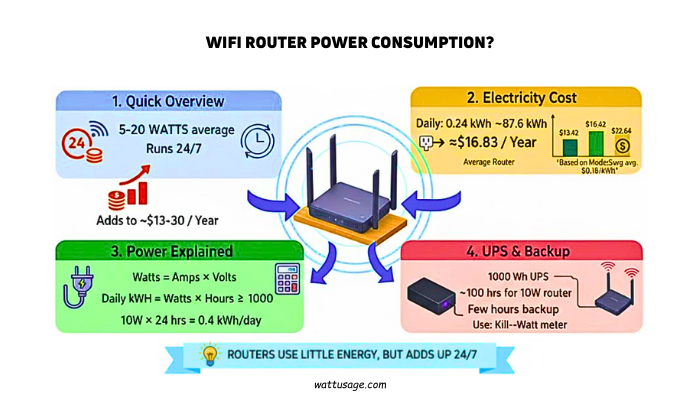
Again it’s very common to ask the question “how many watts does a WiFi router use?”. Although it is a very small appliance in every house.
Let me give you a quick overview.
- Standard home WiFi routers consume 5–20 watts on average.
- Most routers run 24/7, so even low wattage adds up over time.
- Average top-performing routers use around 10 watts.
- High-performance routers or mesh networks may consume more, especially with multiple devices streaming data
| Category | Details |
|---|---|
| Electricity Cost | Using 10W continuously (24 hrs/day): Daily: 0.24 kWh, Annual: ~87.6 kWh → ~$12.95/year |
| Calculating Router Power | Formula: Watts = Amps × Volts; Daily kWh: Watts × Hours ÷ 1,000; Example: 10W × 24 hrs ÷ 1,000 = 0.24 kWh/day |
Therefore, a typical home router consumes 8-10 watts continuously. With peak usage reaching 15–20 watts, while gaming routers can use up to 30%. Most consumer modems and WiFi routers typically consume between 2 and 20 watts during normal operation. With actual usage usually around 10-40 watts per hour for standard devices.
While the maximum rated power listed on labels (for example, 1.5A, 120V = 180W) represents the theoretical maximum, it does not reflect typical consumption. Gaming or high-performance routers may draw more power during heavy network activity. When using a UPS or battery backup, it’s important to remember that the watt rating indicates maximum power output, not battery capacity, which is measured in watt-hours (Wh).
For instance, a 1000 Wh UPS could theoretically power a 10 W router for about 100 hours, and adding extra battery packs can extend runtime significantly.
Some modems even come with built-in batteries that last a few hours without a UPS. It’s best to measure actual power draw with a device like a Kill-A-Watt meter than relying solely on label specifications.
Overall, standard routers and modems consume very little energy. Although making it easy to run them for extended periods on a reasonably sized UPS. A WiFi router that runs 24/7 typically consumes about 8 Wh, totaling roughly 192 Wh per day. During peak usage, such as 10 hours of heavy traffic, consumption can rise to 15 Wh. However, bringing daily use to around 262 Wh.
A WiFi router that runs 24/7 typically consumes about 8 Wh, totaling roughly 192 Wh per day. During peak usage, such as 10 hours of heavy traffic, consumption can rise to 15 Wh, bringing daily use to around 262 Wh. Over a year, this adds up to approximately 95.6 kWh.
With electricity priced at $0.18 per kWh, keeping a standard router always on costs about $16.83 annually.
Gaming routers, which can use up to 30% more power, like an Asus ROG, could push the yearly cost to around $22.44, while budget models consuming up to 25% less may only cost $13.42 per year.
Assuming a higher average electricity cost of $0.33 per kWh, the yearly expenses increase. An average router costs $31.50, a gaming router $41.69, and a budget model $26.40.
How much does it cost to run a WiFi Router?
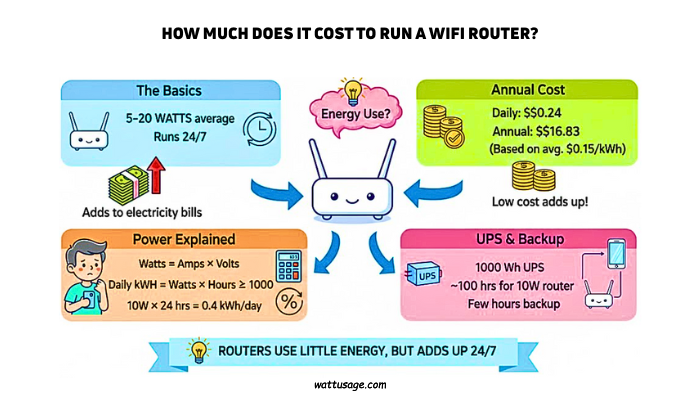
Running a WiFi router continuously at 10 W consumes about 0.24 kWh per day, which adds up to roughly 87.6 kWh over a year. In Florida, where electricity costs around 14.79¢ per kWh, this amounts to approximately $12.95 annually.
Costs can vary depending on location higher rates in states like California or New York will increase the yearly expense. For example, in New York, with an average electricity price of about 22¢ per kWh, running the same router nonstop would cost nearly $19.30 per year. To save energy and reduce costs, a simple tip is to turn off your router when it’s not in use.
Conclusion
Internet has become a basic necessity, and questions like “how many watts does a WiFi router use?” are increasingly common. It’s normal to wonder about a device that runs 24/7 in every home. Standard home WiFi routers typically consume 5–20 watts, with top-performing models averaging around 10 watts.
High-performance routers or mesh networks can draw more, especially when multiple devices are streaming simultaneously. Even though routers are small appliances, continuous operation means that even low wattage adds up over time.
Most consumer modems and routers use 2–20 watts under normal conditions. With actual usage usually between 10–40 watts per hour for standard devices.
The UPS Psychology:
When using a UPS, it’s important to note that the watt rating reflects maximum power output, which is measure (KWh).
For instance, a 1000 Wh UPS could theoretically power a 10 W router for about 100 hours, and adding extra battery packs can extend runtime significantly.
Some modems even come with built-in batteries that last a few hours without a UPS.To ensure accuracy, it’s best to measure actual power draw using a device like a Kill-A-Watt meter, rather than relying solely on label specifications.
Overall, standard routers and modems consume very little energy, making it easy to run them for extended periods on a reasonably sized UPS.
A WiFi router running 24/7 typically consumes about 8 Wh, or roughly 192 Wh per day. During peak usage, such as 10 hours of heavy traffic, consumption can rise to 15 Wh. Over a year, this totals approximately 95.6 kWh.
At an electricity rate of $0.18 per kWh, keeping a standard router on all year costs about $16.83 annually.
Gaming routers, which can use up to 30% more power, like an Asus ROG, could cost around $22.44 per year. Meanwhile budget models consuming 25% less may only cost about $13.42 annually.
At higher electricity prices of $0.33 per kWh, the yearly cost rises to $31.50 for an average router.
Call to action; Monitor your router’s power use and consider energy-saving measures. Turn it off when not needed, or choose an efficient model to save money and reduce energy consumption.
FAQs: How Much Does It Cost to Run a WiFi Router?
- How many watts does a WiFi router use?
Most home routers consume 5–20 watts, depending on model and features. Average consumption is around 10 watts. - How much energy does a router use daily?
A router using 10W continuously for 24 hours consumes 0.24 kWh/day. - What’s the annual cost of running a WiFi router?
Using the average U.S. electricity rate (14.79¢/kWh in Florida), it costs about $12.95/year. Costs vary depending on your state’s electricity rates. - Do high-performance or gaming routers use more power?
Yes, gaming routers or mesh networks can use up to 30% more, slightly increasing annual energy costs. - Can I save electricity by turning off my router at night?
Yes. Turning off the router when not in use can reduce energy use. But the savings are relatively small compared to larger appliances. - Can I power a WiFi router off-grid?
Yes. A portable solar power stations like the Eco-Flow RIVER 2 or Pro can power routers during outages or off-grid setups.
Read our related article to learn more about power usage and everyday electricity costs.
