
The PlayStation 5 is not just a gaming console it’s a doorway to other worlds. With its powerful graphics, lightning-fast load times, and immersive gameplay, it has redefined entertainment for millions. For some, it’s relaxation; for others, it’s competition; and for many, it’s a way of life. But behind the fun, there’s a practical question:
How much electricity does a PS5 use; both Running vs Rest Mode
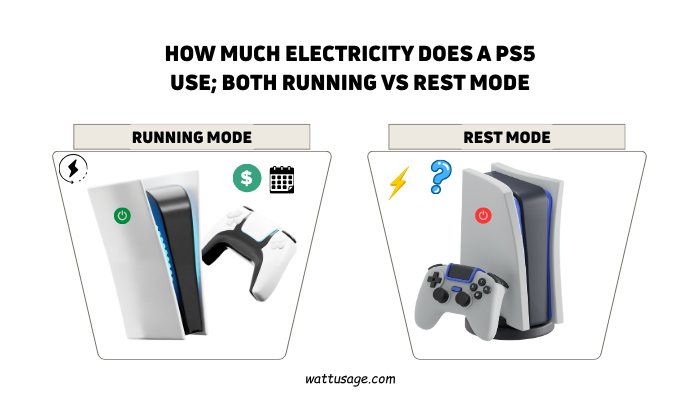
On average, the PS5 consumes between 200 and 220 watts while gaming. In rest mode, it drops to around 0.5 to 5 watts, depending on whether background downloads are running. Streaming videos on apps like Netflix usually consumes less power, around 50 to 70 watts.
Let’s break it down with an example. If you play for 3 hours a day at 200 watts, that equals 0.6 kWh daily. Over a month, that’s 18 kWh. At an electricity rate of $0.15 per kWh, the cost comes to about $2.70 per month. Even heavy gamers who play 5–6 hours a day would rarely spend more than $5 to $7 monthly in electricity for their PS5.
Compared to the price of games, accessories, and subscriptions, the electricity cost is surprisingly small. Yet, for millions of gamers worldwide, this little cost adds up to a big global energy footprint.
I remember the first time I held a PS controller in my hands. It wasn’t just about playing a game it was about escaping into a new reality. Hours would pass in what felt like minutes. But then came the electricity bill, and I realized: even escapes have costs. The PS5 doesn’t just spend watts, it spends time sometimes too much of it.
There are ways to reduce how much the PS5 spends. For instance, enabling power-saving settings ensures the console shuts down instead of staying in rest mode. Reducing screen brightness on connected TVs also helps indirectly. And playing responsibly not for endless hours saves both energy and personal well-being.
From a broader perspective, gaming consoles are becoming more energy-efficient. The PS5, though more powerful, is more efficient per unit of performance compared to older consoles like the PS4 Pro. Still, the fact remains that with millions of players worldwide, every small choice turning it off when not in use, avoiding long idle times makes a difference when multiplied across households.
The PS5 is not just about electricity. It is about stories, challenges, and adventures that unfold on a screen. It spends a little power, yes, but it gives back laughter, excitement, and sometimes even friendships formed across online worlds. The lesson is simple: enjoy it, but don’t let it spend more than it should not in watts, not in hours of life.
Is PS5 Power Efficient:
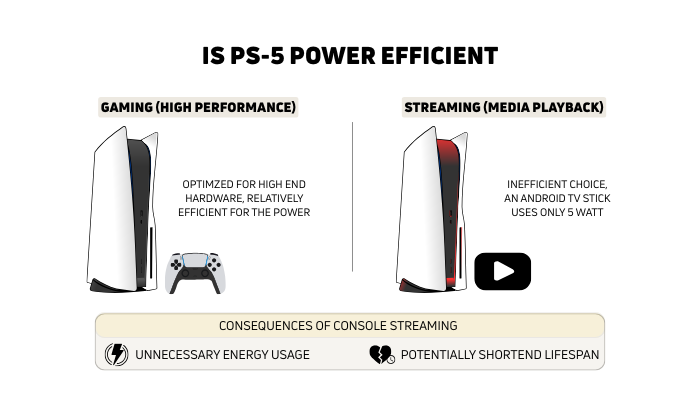
When it comes to gaming consoles, the PS5 is relatively power-efficient considering the high-end hardware it carries. Sony designed it to deliver top-tier performance while keeping power consumption optimized, whether you’re gaming, streaming, or leaving it in standby mode. However, the real efficiency of the PS5 depends on how you use it.
To put that into perspective, an Android TV stick (like Amazon Fire Stick or Chromecast) uses only about 5 watts, and can even be powered directly through your TV’s USB port. So yes, the PS5 is powerful, but it’s definitely not the most efficient choice for media streaming.
This isn’t just about the PS5 previous consoles like the PS4 and Xbox Series X behave the same way. Consoles are designed for high-performance gaming, not low-power streaming. That’s why using them as your everyday media player can lead to unnecessary energy use and potentially shorten the console’s lifespan over time due to extra heat cycles and wear.
Still, the extra cost isn’t massive. Even with heavier use, you might only see a small bump maybe a few dollars per month on your electricity bill. For example, one user found that running a PS3 24/7 for a whole month only added about $17 to their bill.
| Usage Scenario | Average Power Draw (Watts) | Daily Usage (Hours) | Daily Energy Use (kWh) | Annual Energy Use (kWh) | Cost per kWh | Estimated Annual Cost (USD) |
|---|---|---|---|---|---|---|
| Casual Gamer | 200W | 2 hrs/day | 0.4 | 146 | $0.15 | $21.90 |
| Regular Gamer | 200W | 3 hrs/day | 0.6 | 219 | $0.15 | $32.85 |
| Heavy Gamer | 220W | 6 hrs/day | 1.32 | 481.8 | $0.15 | $72.27 |
| Media Streaming Only | 60W | 3 hrs/day | 0.18 | 65.7 | $0.15 | $9.86 |
| Rest Mode (Idle) | 3W | 24 hrs/day | 0.072 | 26.3 | $0.15 | $3.95 |
| Efficient Setup (Power-Saving Enabled) | 200W gaming / 1W rest | 3 hrs gaming + 21 hrs rest | 0.63 | 230 | $0.15 | $34.50 |
Check out Mama’s hacks for a smarter way to use electricity and save some bucks.
How much power does a PS5 use Per Hour?
We don’t need to be so worried about the per second rate of the electricity used by PS5. The PS5 uses about 200W while gaming, so unless you’re playing non-stop 24/7, it’s unlikely to be the main cause on your electricity bill.
Estimating how much electricity your PS5 consumes is easier than it sounds. On average, the console draws around 200 watts, but during intense gaming sessions, it can peak at 260 watts. Let’s imagine a scenario where you play for 20 hours out of 24 at peak power essentially a heavy gaming day.
To calculate the daily electricity usage, you multiply the power consumption by the number of hours used. In this case, 260 watts × 20 hours equals 5,200 watts per day. Converting this into kilowatt-hours, the standard unit for electricity billing, you divide by 1,000, giving 5.2 kWh per day.
Extending this to a month, assuming 30 days of usage, the PS5 would consume 156 kWh. To translate this into cost, multiply by the electricity rate in your area. At P13 per kWh, the total comes out to around P2,028 per month.
This example represents a maximum-usage scenario playing almost the entire day at peak power. In reality, most gamers play far fewer hours, meaning the actual electricity cost would be much lower.
Let me give you a formula and its usage, we don’t need to just rely on my blog and some social media platforms lets calculate by our own.
Formula to Calculate Your PS5 Electricity Usage:
Monthly Cost= Power (kW) × Hours/day × Days/month × Electricity Rate
- Power (kW) = PS5 wattage ÷ 1,000 (1 kilowatt is equal to 1000 watts W)
- Hours/day = How long you actually play
- Days/month = Number of days you use the PS5 (ignore this if you only need per/hour of the PS5 consumption rate)
- Electricity Rate = Cost per kWh in your area
How many watts does a PS5 use?
This part can get a little tricky because we have two perspectives to consider: the PS5’s running mode and its standby mode. One question we hear a lot is: “How many watts does a PS5 actually use?” and the answer is simpler than most think.
Some people assume that the PS5 consumes more power in standby than while gaming. That’s partly true, but not always. Here’s why: nobody usually leaves their console in standby for more than a day. However, if a PS5 stays in standby for extended periods, it can start using more power than during normal gameplay.
In numbers: in standby mode without a network connection, the PS5 uses about 1.5W, and when it’s powered off but still plugged in, it draws roughly 1.3W.
However in the running mode, the PS5 consumes about 200 to 220 watts, while the disc version of the PS5 console has a 350W power rating.
For example, when you are playing Call of Duty, the PS5 can consume around 203W during the most intense moments. On average, you can expect about 177W for typical gameplay, which is similar to other action-packed shooters.
| Mode | Condition | Power Consumption (Watts) | Example |
|---|---|---|---|
| Running / Gameplay | Average gameplay | 177W | Typical action-packed shooters |
| Intense gaming (eg; Call of Duty) | 203W | Peak moments during gameplay | |
| Disc version maximum | 350W | Full power rating of disc PS5 | |
| Standby | Standby, no network | 1.5W | Low power draw when console idle |
| Powered off, plugged in | 1.3W | Minimal power while still connected |
At first peek, the PS5’s wattage might seem like a tiny whisper in your electricity bill but for an enthusiastic gamer who battles through hours of epic campaigns day after day, those watts quickly snowball into a storm of energy.
Every intense shootout, every pulse-pounding moment in Call of Duty, adds up, and suddenly the console isn’t so innocent anymore. That’s why learning to use your gaming console wisely isn’t just smart, it’s essential if you want to keep your power consumption from out of control.
How many wattage does a PS4 Vs PS5 use?
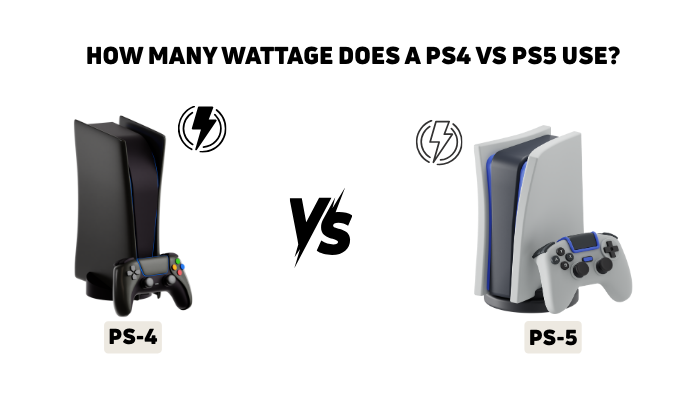
This is very simple, look the more we move towards modern the more efficient we become. The same is with these two players, the predecessors of PS5 are always considered to be more power consumable as compared to it.
In Rest Mode, the PS5 barely sips power only 1.3W even with every feature switched on. Compare that to the PS4 Pro, which gulps around 5W in the same state. But the moment you jump into active game play, the story changes fast: the PS5’s power draw rises sharply, showing where the real consumption begins.
Conclusion
The PS5 is not an electric monster just a powerful machine with a steady role. It sips only a few watts in rest mode and eats a couple hundred while gaming. Small numbers on their own, but for a hardcore gamer, they add up fast.
Play smart. Don’t leave it resting for no reason. Turn on power-saving features. Shut it down when the battle ends.
Because in the end, both your watts and your gaming hours matter and neither should be wasted.
F&Qs:
How much electricity does a PS5 use per hour?
A PS5 uses around 170–220 watts per hour during gameplay, depending on the game’s intensity.
Does Rest Mode consume a lot of electricity?
No. The PS5 uses 1.3–1.5W in Rest Mode very low compared to gaming mode.
Will gaming for long hours make my electricity bill higher?
Yes. Longer gaming sessions mean more watt-hours consumed. A heavy gamer can easily add 100–150 kWh per month.
PS5 Power Consumption vs PS4?
The PS5 is more powerful, so it naturally consumes more electricity:
- PS5 Gameplay: ~200W
- PS4 Slim: ~90–120W
- PS4 Pro: ~150–165W
