
When you first glance at a high-end massage chair, your mind probably jumps straight to: “How Much Electricity Does a Massage Chair Use?” And, honestly, most people brace themselves for a shocking number.
Let’s break it down. Take the fanciest model with every gadget and feature-packed in, what’s actually pulling power from your standard 110V outlet? You’ve got the basics.
A power supply, a power circuit board, a motherboard, three 110V motors, dedicated motors for the back recline and footrest, two air compressors, an infrared heating element in the backrest and leg units, and yes, the remote control that lets you boss the chair around like it owes you money.
Sounds like a monster energy-sucker, right?
Here’s the kick: even with everything running full throttle, the maximum power draw is just 200 watts.
To put that in perspective:
- A iron? 800–1,000 watts.
- A desktop computer? 200–400 watts.
When the chair isn’t in use, it only draws a tiny bit of “standby” power, almost nothing. So, your top-of-the-line massage chair won’t drain your electricity. You can enjoy full-body massages without worrying about the power bill.
Massage Chair Power Consumption
Every Massage Chair Power Consumption story starts with its key components drawing electricity continuously.
Air compressors, infrared heating elements, and even the remote contribute to power usage, but minimally and efficiently. Modern chairs use smart engineering to reduce wasted energy, keeping power consumption low while providing full functionality.
If used one hour per day, some chairs use only about 0.15 to 0.3 kilowatt‑hours. In many cases, this adds only a little to your monthly electricity bill. Standby power when the chair is not used is minimal, almost nothing.
| Chair | Power Consumption (Watts) | Comparison |
|---|---|---|
| Massage Chair (basic) | 100–150 W | Low energy; comfortable full-body massage |
| Massage Chair (high-end, full features) | 200–300 W | Includes rollers, airbags, heat, recline functions |
| Desktop Computer | 200–400 W | Similar to high-end massage chair |
| Microwave Oven | 800–1,200 W | Uses 4–6 times more power than massage chair |
| Iron | 800–1,000 W | Very high energy compared to massage chair |
| LED Light Bulb | 10–20 W | Tiny energy use compared to massage chair |
| Standby Power (Massage Chair) | 1–5 W | Almost negligible when not in use |
Cost of Using a Massage Chair
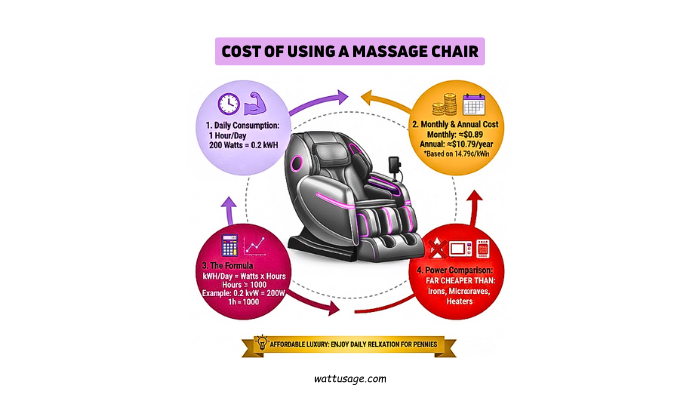
- Massage Chair Power Consumption directly affects electricity cost. Calculating cost is simple: multiply daily kWh by local electricity rate.
- Example: 200 watts × 1 hour/day = 0.2 kWh/day.
- Monthly usage: 0.2 × 30 = 6 kWh, costing about $0.89 if 14.79¢/kWh.
- Annual usage: 0.2 × 365 = 73 kWh → ~$10.79/year in electricity.
- Even daily use remains far cheaper than running irons, microwaves, or heaters.
Tips to Minimise Massage Chair Power Consumption
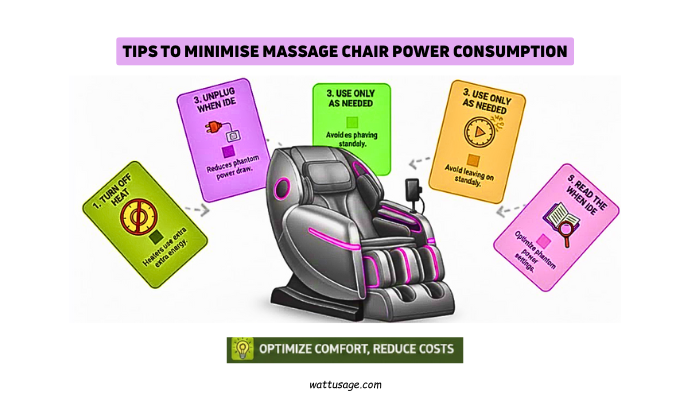
Massage Chair Power Consumption can be further optimised using simple habits. Turn off heating when not necessary to save small amounts of energy.
Use chair only for the desired duration; avoid leaving it on standby. Unplug the chair if it won’t be used for several days. Check your chair’s manual for power settings and energy-saving features. Choose chairs labeled “energy-efficient” for long-term savings and better design.
These small tips reduce electricity cost even more while maintaining comfort.
Conclusion
Understanding Massage Chair Power Consumption helps users enjoy comfort without worrying about electricity costs. Modern massage chairs are designed to combine full-body massage with energy efficiency. High-end chairs rarely exceed 200–300 watts during operation and only 1–5 watts in standby.
Daily use remains affordable, costing less than $1 per month in most regions. Practical habits further reduce power use, making relaxation both luxurious and cost-effective.
FAQs
Q1: Does Massage Chair Power Consumption vary by model?
Yes, advanced chairs with more features usually use slightly more power.
Q2: Will daily use significantly raise my electricity bill?
No, daily sessions rarely increase monthly bills by more than a few cents.
Q3: Does heat add more power consumption?
Yes,using heating elements can increase consumption by 50–100 watts.
Q4: Is standby power significant?
No, most chairs use minimal standby energy, barely affecting bills.
Q5: How can I calculate my own electricity cost?
Multiply daily kWh by your local electricity rate, then extend for month or year.
