
“How much electricity does an electric car use?” is a common question for people considering EVs today.
Electric cars rely entirely on electricity stored in batteries, unlike conventional vehicles that burn gasoline or diesel.
Understanding how much electricity an electric car uses helps plan monthly energy costs efficiently.
It also allows owners to choose the right charging routine while balancing comfort, convenience, and eco-friendliness. Many first-time EV users wonder if home charging will inflate their electricity bills, but the truth is manageable.
Understanding Electric Car Electricity Usage
Electric cars measure energy consumption in kilowatt-hours (kWh), which is the electricity unit powering the vehicle.
Most modern EVs consume 15–30 kWh per 100 miles, depending on battery size, driving style, and efficiency.
Smaller city EVs usually use 15–20 kWh per 100 miles, while SUVs and performance cars consume 25–30 kWh.
Battery efficiency, aerodynamics, and driving speed all influence electricity consumption significantly. For example, maintaining highway speeds consumes more power than steady city driving due to wind resistance.
Even small habits, like accelerating gently and using eco mode, can reduce electricity use noticeably.
Factors Affecting Electricity Consumption
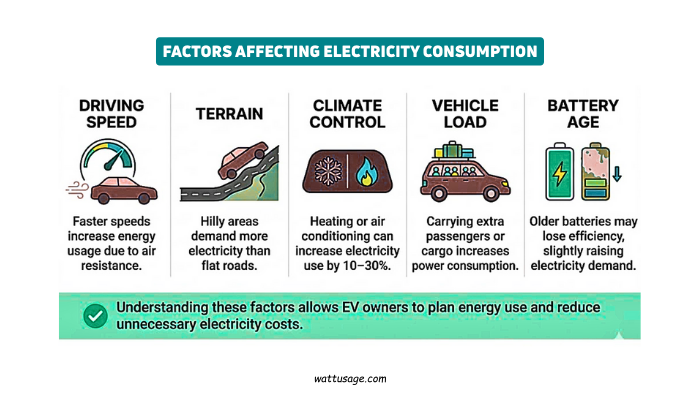
- Driving Speed – Faster speeds increase energy usage due to air resistance.
- Terrain – Hilly areas demand more electricity than flat roads.
- Climate Control – Heating or air conditioning can increase electricity use by 10–30%.
- Vehicle Load – Carrying extra passengers or cargo increases power consumption.
- Battery Age – Older batteries may lose efficiency, slightly raising electricity demand.
Understanding these factors allows EV owners to plan energy use and reduce unnecessary electricity costs.
Home Charging Electricity Costs
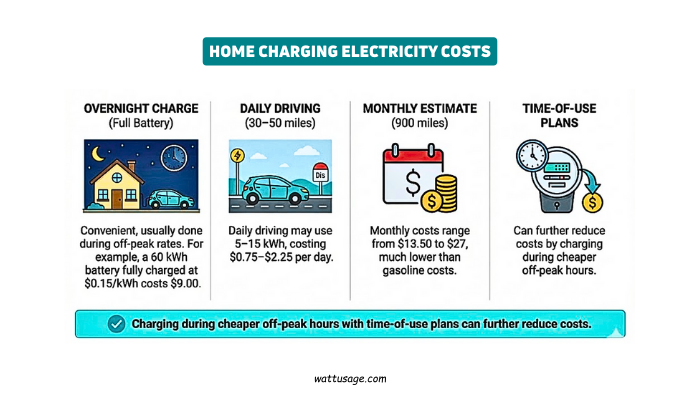
Charging an electric car at home is convenient, usually done overnight during off-peak electricity rates.
For example, a 60 kWh battery fully charged at $0.15/kWh costs $9.00.
- Daily driving of 30–50 miles may use 5–15 kWh, costing $0.75–$2.25 per day.
- Monthly electricity costs for average driving (900 miles/month) range from $13.50 to $27, much lower than gasoline costs.
Time-of-use electricity plans can further reduce costs by charging during cheaper off-peak hours.
Types of Home Chargers
- Level 1 (120V) – Slow charging, adding 3–5 miles per hour, ideal for overnight charging.
- Level 2 (240V) – Faster charging, adding 15–30 miles per hour, common for home installations.
- Smart Chargers – Monitor energy usage, schedule charging, and maximize off-peak efficiency.
Home charging allows flexibility and control over electricity consumption and helps reduce costs.
Public Charging vs Home Charging
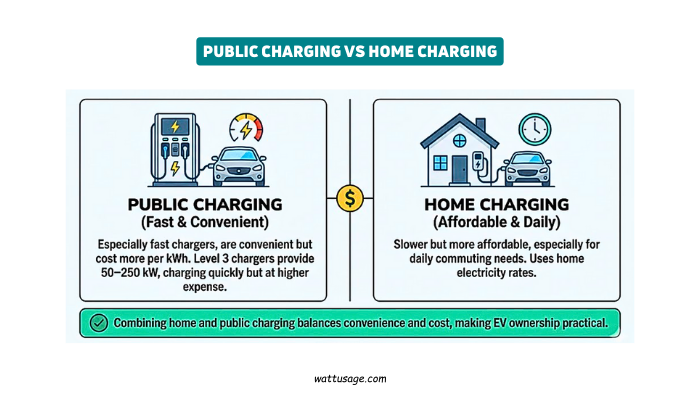
Public charging stations, especially fast chargers, are convenient but cost more per kWh than home electricity.
Level 3 chargers provide 50–250 kW, charging an EV quickly but at higher expense. Home charging is slower but more affordable, especially for daily commuting needs.
Combining home and public charging balances convenience and cost, making EV ownership practical.
Comparing Electricity Usage: EVs vs Gasoline Cars
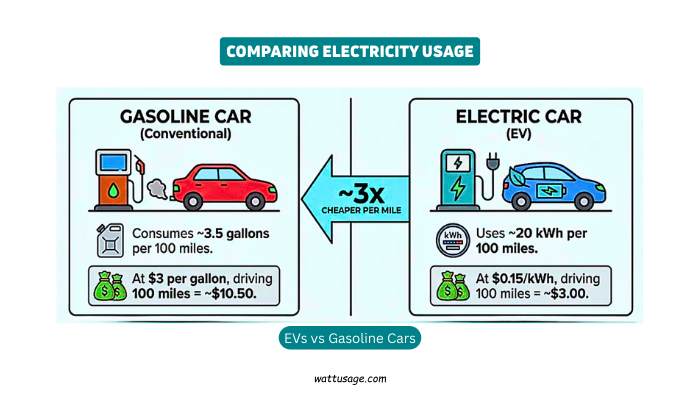
A gasoline car consumes roughly 3.5 gallons per 100 miles, depending on fuel efficiency.
At $3 per gallon, driving 100 miles costs about $10.50.
In comparison, an electric car using 20 kWh per 100 miles at $0.15/kWh costs only $3 for the same distance. This makes EVs approximately three times cheaper per mile in energy costs than gasoline vehicles.
Additionally, EVs produce no tailpipe emissions, further supporting environmentally friendly transportation.
Practical Driving Reflection
Charging an EV feels routine, like plugging in a smartphone each night.
Smart charging habits, like overnight charging and eco-driving, reduce electricity costs significantly.
Regenerative braking allows vehicles to recover energy, extending range and lowering overall electricity consumption.
Many EV owners notice that gentle acceleration and speed control greatly improve efficiency.
Driving with air conditioning or heater on increases electricity use, especially during extreme weather.
Battery Size and Electricity Use
EV battery sizes vary from 30 kWh to 100 kWh, directly affecting electricity consumption per charge.
Smaller batteries are lighter and more efficient, but require more frequent charging for longer trips. Larger batteries store more energy, providing extended range but consuming more electricity per full charge.
Understanding battery capacity helps predict monthly electricity costs and manage home energy usage.
Environmental Impact
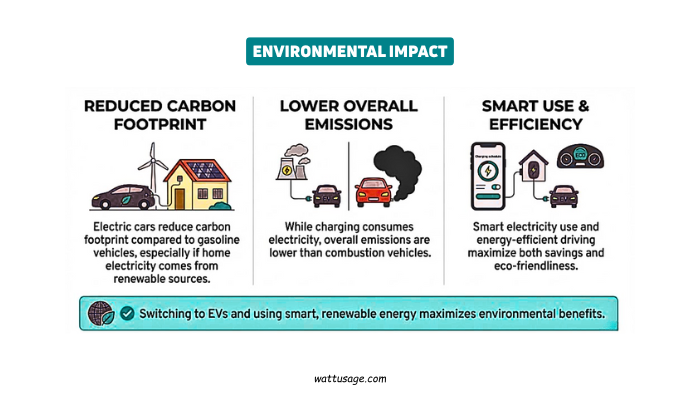
Electric cars reduce carbon footprint compared to gasoline vehicles, especially if home electricity comes from renewable sources.
While charging consumes electricity, overall emissions are lower than combustion vehicles.
Smart electricity use and energy-efficient driving maximize both savings and eco-friendliness.
Cost Breakdown Examples
| Vehicle | Battery Size (kWh) | Consumption (kWh/100 miles) | Daily Miles | Daily kWh | Daily Cost ($) | Monthly Cost ($) |
|---|---|---|---|---|---|---|
| Small City EV | 40 kWh | 15 kWh | 30 | 4.5 | 0.68 | 20.4 |
| Mid-size EV | 60 kWh | 20 kWh | 40 | 8 | 1.20 | 36 |
| SUV EV | 90 kWh | 25 kWh | 50 | 12.5 | 1.88 | 56.4 |
From this, even high-capacity EVs remain cheaper to operate than gasoline cars.
Tips to Reduce Electric Car Electricity Use
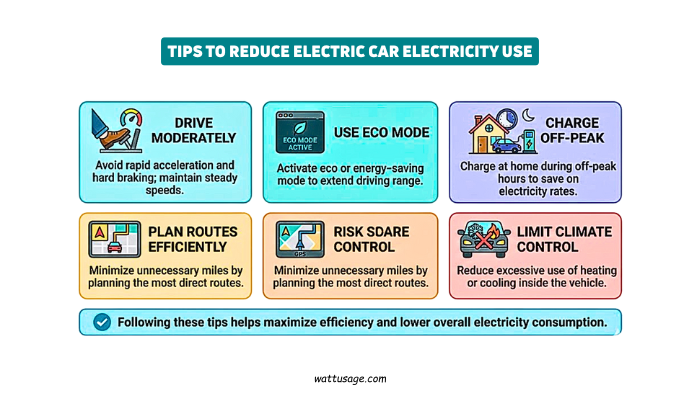
- Drive moderately; avoid rapid acceleration and hard braking.
- Use eco or energy-saving mode for longer range.
- Charge at home during off-peak hours to save on electricity rates.
- Plan routes efficiently to minimize unnecessary miles.
- Limit excessive use of heating or cooling inside the car.
Conclusion
Electric cars typically use 15–30 kWh per 100 miles, depending on size, terrain, and driving habits.
Home charging costs $0.75–$2.25 per day for average driving, much lower than fuel costs for gasoline cars.
Understanding energy usage, battery size, and driving habits ensures efficient and cost-effective EV ownership.
EVs provide environmental benefits, reduce emissions, and offer long-term savings on fuel and electricity.
FAQs
Q1: How far can an electric car travel on a full charge?
Ranges vary between 150–350 miles depending on battery size, vehicle type, and driving conditions.
Q2: Does using AC or heater affect electricity use?
Yes, climate control can increase energy consumption by 10–30%, depending on outside temperature.
Q3: Are public chargers more expensive than home charging?
Usually, yes. Public fast chargers cost more per kWh but provide faster charging.
Q4: How does regenerative braking help?
It recovers energy during braking, extending driving range and reducing electricity consumption.
Q5: How much does it cost to drive 100 miles in an EV?
Roughly $3–$4 at $0.15/kWh, significantly cheaper than a gasoline car driving the same distance.
